
Dawn Redwoods Facts
| FACT | WHERE |
|---|---|
| Tallest Dawn Redwood in China: 120 feet | Lubeiba, Hubei |
| Native range: Sichuan-Hubei region | South-central China |
To learn more about redwoods, visit our Redwood Forest Facts page.
About Dawn Redwoods
Changing Colors
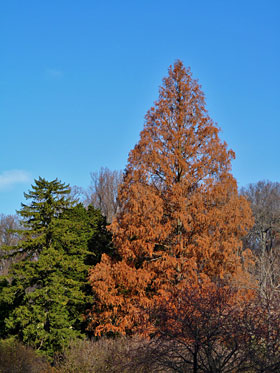
To the Chinese people, the dawn redwood is second only to the panda as a conservation icon. Thought to have been extinct for millions of years, a Save the Redwoods League group discovered that this unusual member of the redwood family still exists in China, shedding its leaves in the fall.
History
The dawn redwood was once one of the most widespread tree species in the Northern Hemisphere (during the Tertiary period). Scientists had identified fossil remains of this redwood in North America, Asia and Greenland and had concluded that it must have been extinct for millions of years. However, in 1944, a Chinese forester found an enormous dawn redwood in the Sichuan province of China. In 1948, a small group—partially financed by Save the Redwoods League and including future League President Ralph Chaney—traveled to south-central China and found a few thousand of the trees growing in lowland canyons. Villagers in the Sichuan region were using the foliage for cattle fodder and the wood for bridges and other construction. The dawn redwood tree, thought to have been extinct for 20 million years, now had living representatives known to the world.
Biology
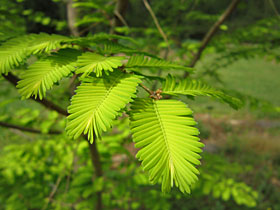
Dawn redwoods’ colorful leaves are one trait that separates this species from its family members. The only living species in its genus, the dawn redwood is a deciduous tree rather than an evergreen. This means that it sheds its leaves in the fall, is bare in winter and grows new leaves in the spring. It is also the smallest of the three redwoods: dawn redwoods are typically between 50 and 60 feet tall, but can grow taller than 160 feet with a trunk about 7 feet in diameter. It is considered a fast-growing tree and is often planted as an ornamental.
Conservation
Today you can see naturally occurring populations of dawn redwoods in various locations in China, including the hills and wetlands of Hubei’s Lichuan County and the Hunan Province. In the United States, you can find 200 dawn redwoods at the Crescent Ridge Dawn Redwoods Preserve (CRDRP) in North Carolina, and at botanical gardens. Dawn redwoods have also been planted in Japan, near schools, museums and temples.
The dawn redwood is commonly known as “water-fir” or “water pine” in China because of its tendency to grow in low-lying areas near rivers and streams—the same conditions that support rice cultivation.
Research
When League-supported researchers traveled to China’s remote Shui-hsu Valley in south-central China in 1948, they found a few thousand trees growing in narrow canyons that opened into the wide valley. Rice and other crops were being cultivated in these lowlands, but the researchers guessed that the valley was probably once covered with dawn redwood forests. Because of its deciduous nature, they also considered the possibility that the dawn redwood could live in regions colder than its current range. They collected cuttings and seeds and sent them to Asia, Europe and North America to be grown in public and private gardens. Their experiments—in which seedlings survived harsh winters in Alaska, British Columbia, Washington and Oregon—found that the dawn redwood is suited to live in environments much colder than China; their range likely once included such frigid climates.
You Can Help
Today, it takes a community including private landowners, parks, local communities, scientists and our supporters, to safeguard redwood forests. Together, we protect redwood forests from threats such as unsustainable development; restore the forests we have lost; and connect people to these towering wonders of nature. With your help, we can leave the forests — and the world — in a better place than we found them.