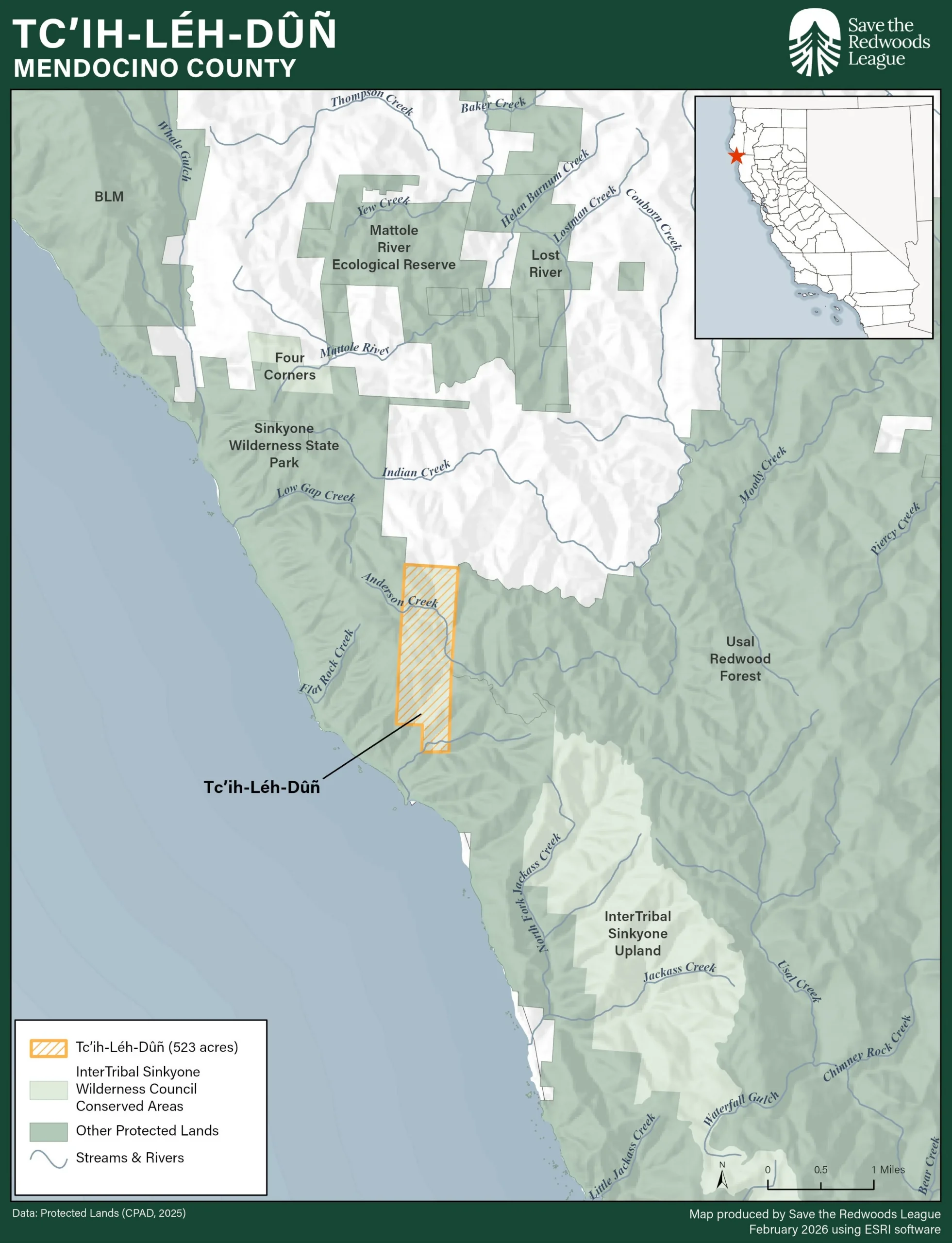
In July 2020, Save the Redwoods acquired 523 acres of lush redwood forestland on what is now known as the Lost Coast, in the heart of traditional Sinkyone territory. In this beautiful and rugged coastal conifer forest adjacent to Sinkyone Wilderness State Park, more than 200 acres of old-growth coast redwoods still tower among healthy younger redwoods, Douglas-firs, tanoaks, and Pacific madrones over a vibrant understory of huckleberries, manzanitas, and ceanothuses.
Save the Redwoods could think of no better partner in the permanent protection and stewardship of this land than the InterTribal Sinkyone Wilderness Council, a nonprofit consortium of 10 federally recognized Tribes with cultural connections to the lands and waters of traditional Sinkyone and neighboring Tribal territories.
Having donated the nearby 164-acre Four Corners property to the Sinkyone Council in 2012, with Save the Redwoods holding a conservation easement there, we proposed a donation of the 523-acre parcel to the Sinkyone Council. In January 2022, the Sinkyone Council formally accepted our offer of the donation and, in turn, granted Save the Redwoods a conservation easement to continue our partnership, which secures the health and the future of these lands together.
The Sinkyone Council has redesignated the land with the original Sinkyone place name: Tc’ih-Léh-Dûñ (pronounced tsih-ih-LEY-duhn), which translates to Fish Run Place. Restoring this place name in the Sinkyone language is an act of cultural empowerment and celebrates Indigenous resilience.
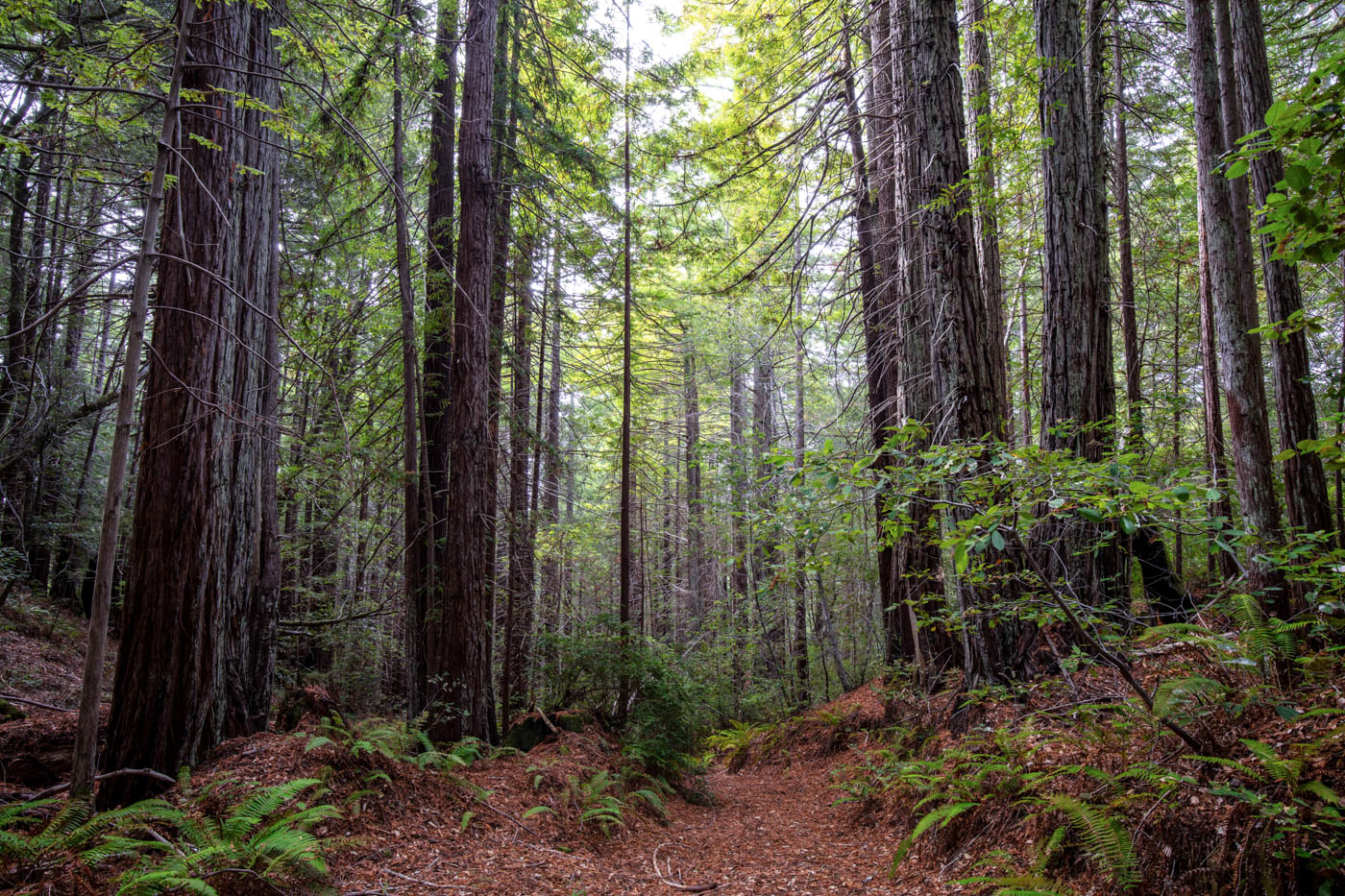
The second-growth trees in Tc’ih-Léh-Dûñ exhibit late-seral characteristics, such as complex crowns and furrowed bark, indicating that they are developing into healthy old-growth trees. Photo by Max Forster.
What we secured
- 523-acre property that includes 200 acres of old-growth coast redwoods
- Restoration of Indigenous guardianship of culturally significant redwood forest
- Conservation easement that permanently protects the land from commercial timber harvesting, development, and subdivision
- A critical habitat corridor and a key inholding of redwood forest in a vast network of approximately 180,000 acres of protected lands
- Habitat for threatened northern spotted owls, endangered marbled murrelets, and many other species
- Class I fish-bearing stream that provides habitat for endangered coho salmon and threatened steelhead trout
- $3.55 million from Pacific Gas & Electric Company through an innovative funding strategy
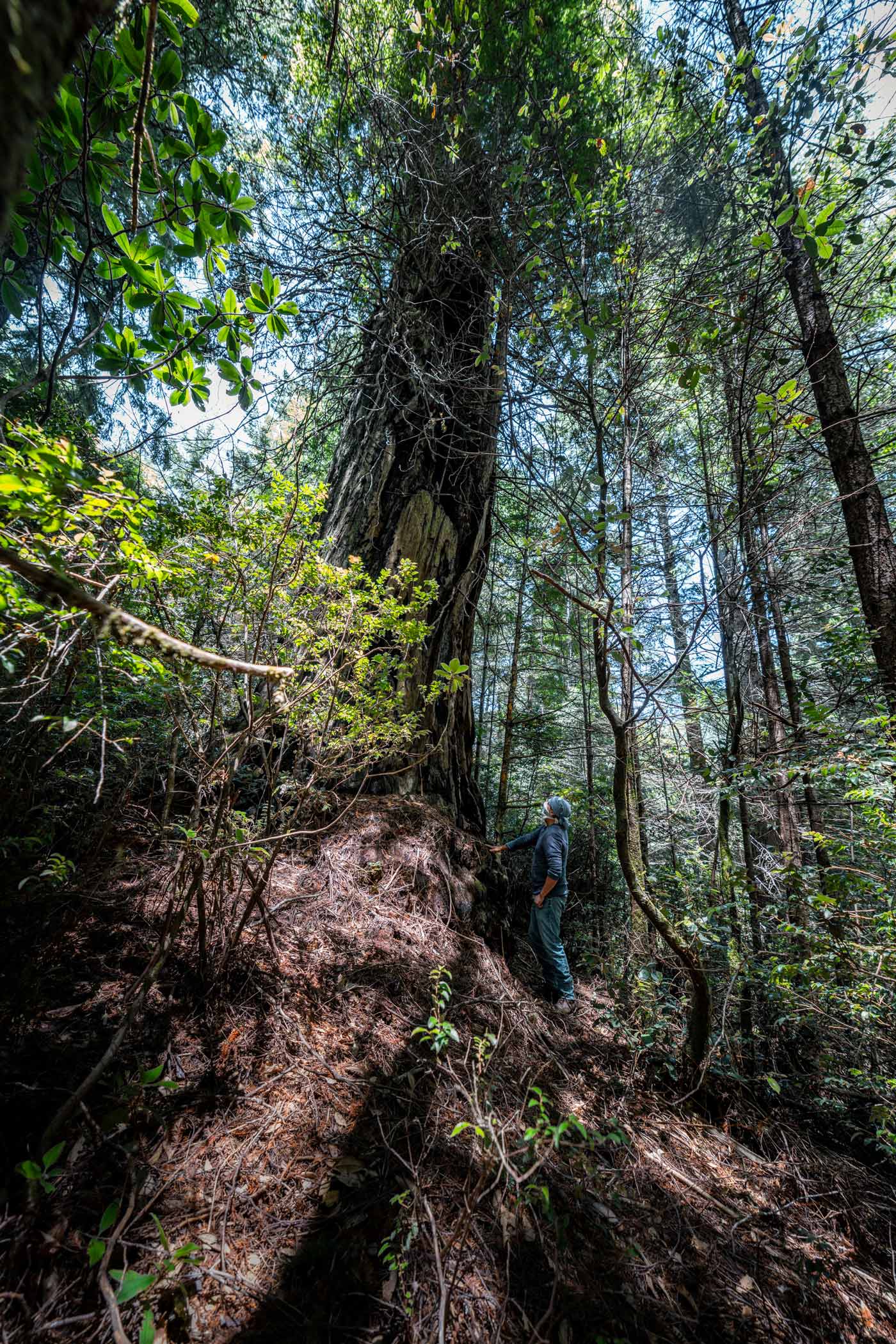
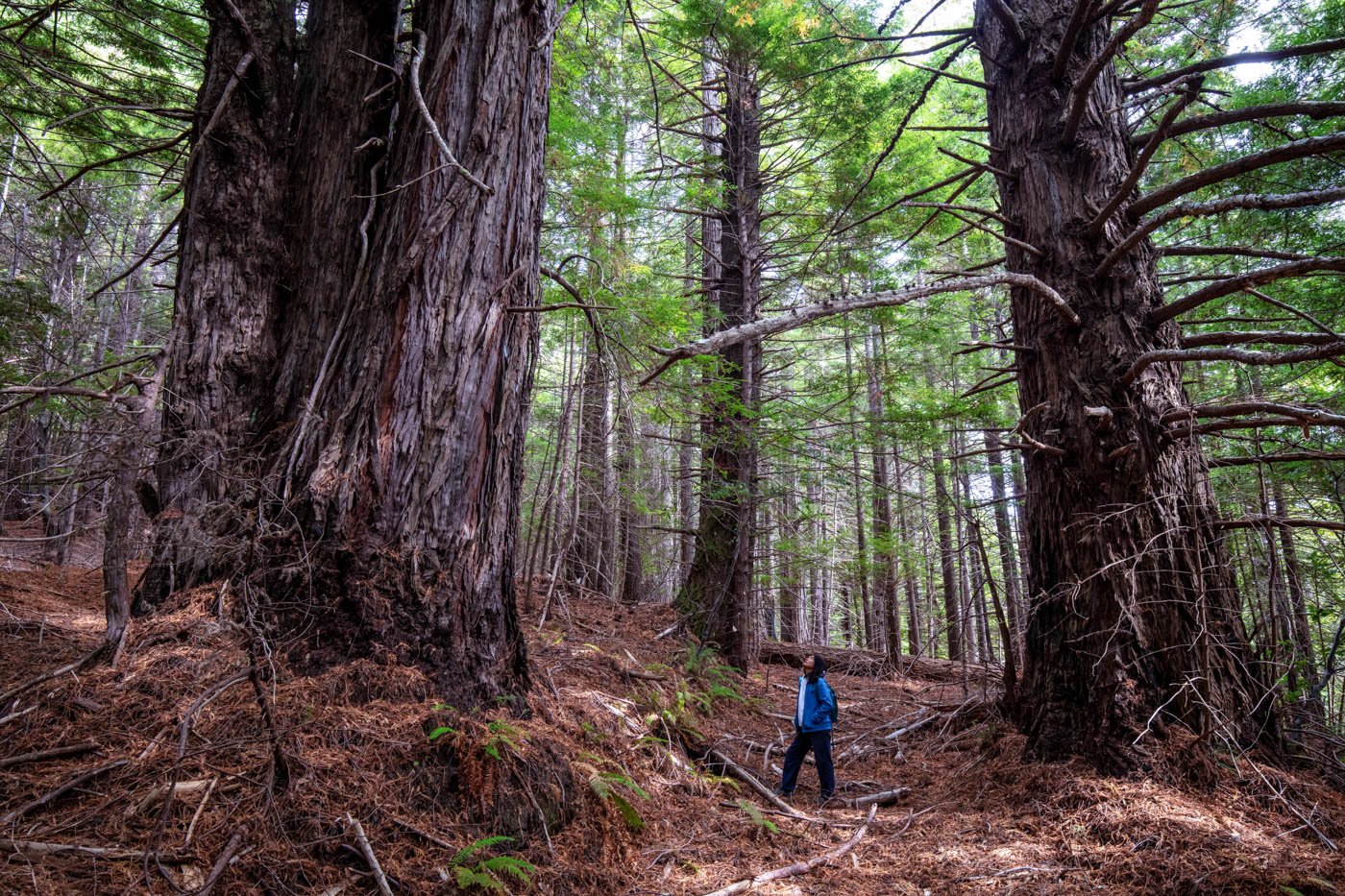
Hawk Rosales, former executive director of the InterTribal Sinkyone Wilderness Council, stands with a large redwood tree in Tc’ih-Léh-Dûñ. Photo by Paul Robert Wolf Wilson.
The Sinkyone people’s sacred connection to Tc’ih-Léh-Dûñ
The word Sinkyone translates to “peoples of the South Fork Eel River.” They were seafaring people, paddling into the open ocean in redwood canoes regarded as living beings. The Sinkyone lived in and traveled throughout coastal, mountain, and valley areas of their territory, gathering traditional foods such as acorns, kelp, seaweed, salt, salmon, deer, elk, and an abundant variety of berries, roots, bulbs, nuts, and seeds. Sinkyone descendants and other Tribal peoples of the region continue to rely on these and other traditional foods.
Starting in the mid-1800s, settlers began massacring and forcibly removing Sinkyone people from these lands they had cared for and called home since time immemorial. Within 15 years, the Sinkyone population had been severely reduced, killed through state-sanctioned murders, starvation, introduced diseases, and other atrocities. The survivors were exiled to reservations far from their homelands, some eventually becoming members of various federally recognized Tribes of the region. Meanwhile, settlers began cutting down the giant redwoods, which Tribes consider as relatives and sacred beings.
Despite the theft of land, displacement, and genocide, the region’s Indigenous peoples have sustained longstanding relationships with their lands and the redwoods, called Gááhs-tcho (pronounced GAAS-cho) in the Sinkyone language. They are still used to craft houses, clothing, baskets, canoes, and fish traps.
Partnering to protect the forest
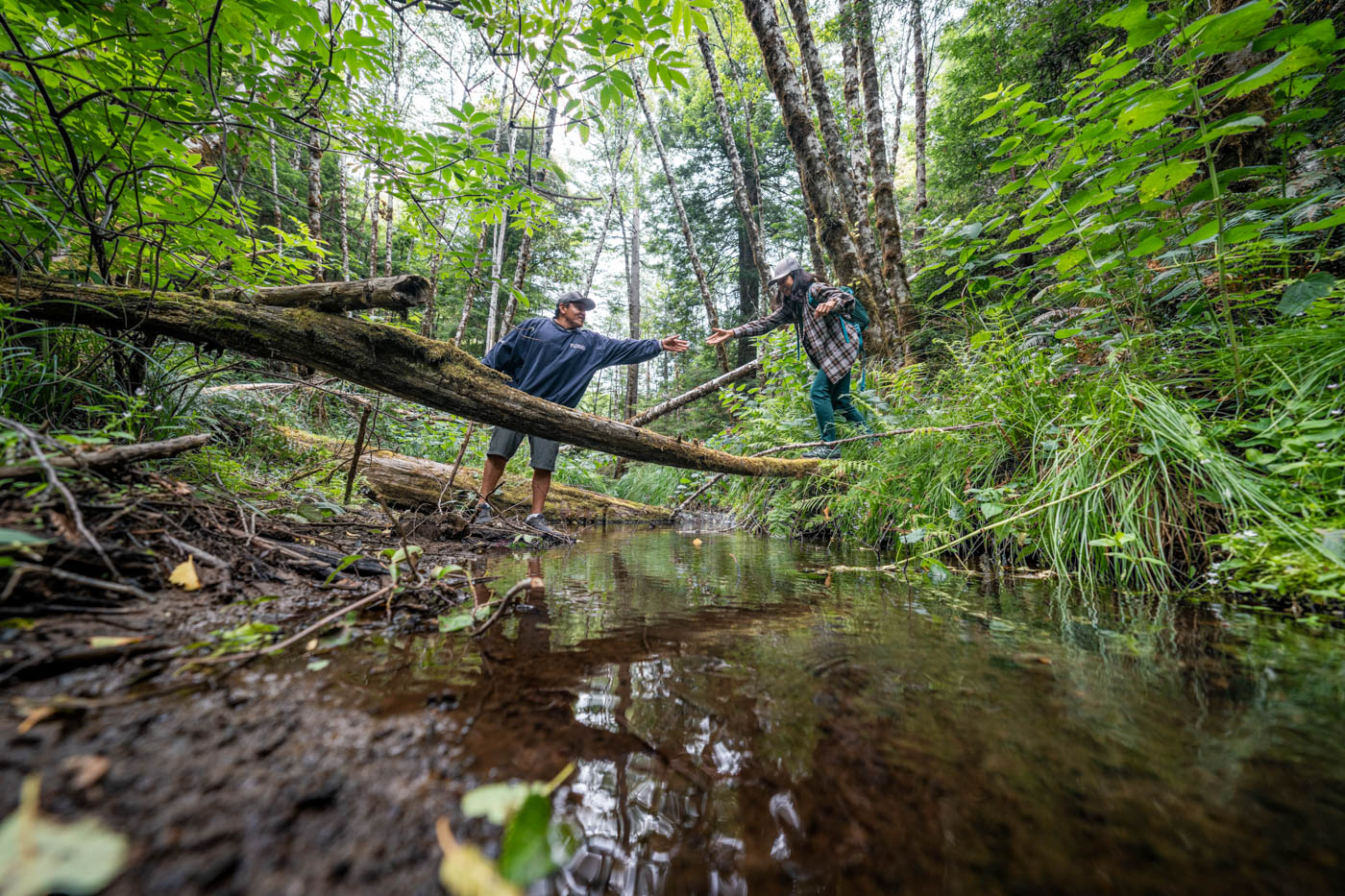
Jaime Boggs (left), board member of the InterTribal Sinkyone Wilderness Council, and a Save the Redwoods staff member navigate a creek crossing in Tc’ih-Léh-Dûñ. Photo by Paul Robert Wolf Wilson.
Founded in 1986, the InterTribal Sinkyone Wilderness Council consists of Cahto Tribe of Laytonville Rancheria, Coyote Valley Band of Pomo Indians, Hopland Band of Pomo Indians, Pinoleville Pomo Nation, Potter Valley Tribe, Redwood Valley Little River Band of Pomo Indians, Robinson Rancheria of Pomo Indians, Round Valley Indian Tribes, Scotts Valley Band of Pomo Indians, and Sherwood Valley Rancheria of Pomo Indians. They joined together to return guardianship of traditional lands to local Tribal people.
Through multiple land acquisition and restoration projects, the Sinkyone Council has been building capacity and expertise to steward lands and waters in the region, collaborating with a variety of project partners, and prioritizing working with and hiring Tribal members for fisheries and watershed restoration, forestry work, and cultural protection initiatives.
They have decades of experience in healing redwood ecosystems damaged from past logging and restoring Tribal relationships with the cultural landscape—and will continue their robust efforts by bringing back traditional stewardship at Tc’ih-Léh-Dûñ.
In addition, under the conservation easement granted to Save the Redwoods, there will be no commercial timber operations, fragmentation, development, or public access to Tc’ih-Léh-Dûñ. The easement also requires the land to be managed according to a Habitat Management Plan approved by the U.S. Fish and Wildlife Service. That plan requires mapping the land’s vegetation and wetlands, and surveying for the presence of northern spotted owls, marbled murrelets, and foothill yellow-legged frogs every few years.
Our innovative approach to funding rematriation
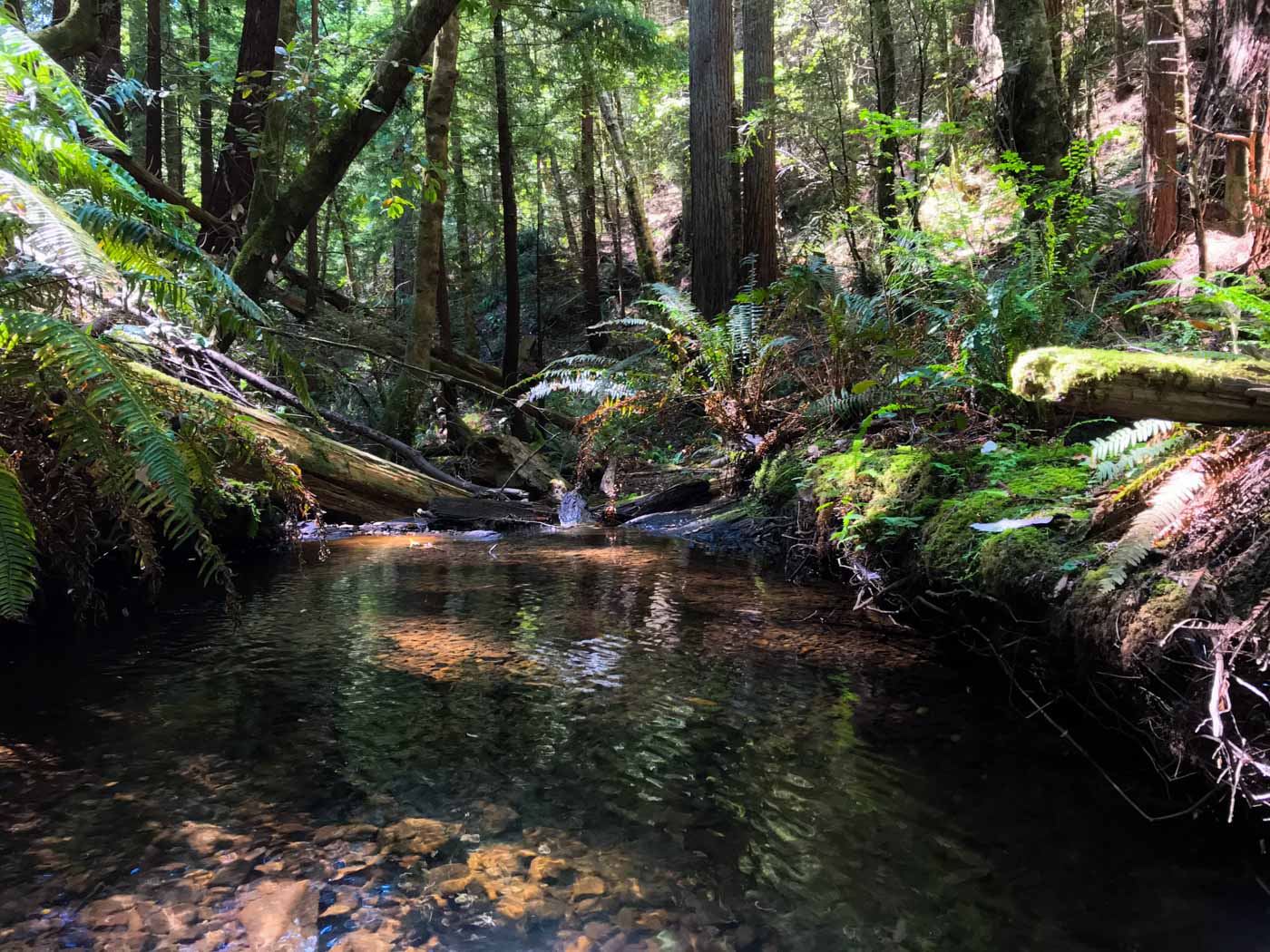
The innovative funding agreement we made with PG&E helped the company meet its 30-year conservation goals for the northern spotted owl and the marbled murrelet, both residents of Tc’ih-Léh-Dûñ’s vibrant coastal redwood forest.
Save the Redwoods fully funded the acquisition and an endowment for long-term stewardship of Tc’ih-Léh-Dûñ by securing $3.55 million from Pacific Gas & Electric Company (PG&E) through a Habitat Acquisition and Management Agreement with the U.S. Fish and Wildlife Service. The agreement was developed to meet PG&E’s 30-year conservation goals for the northern spotted owl and the marbled murrelet.
This innovative funding strategy serves as a potential model for how conservation organizations can facilitate returning land to Tribes—often referred to as rematriation in honor of traditional matriarchal and matrilineal societies.
A new era of conservation
Save the Redwoods’ partnership with the InterTribal Sinkyone Wilderness Council provides a unique opportunity to pivot to a new era of conservation. To meet the state and federal 30×30 goal of protecting 30% of lands and oceans by 2030, meaningful engagement with Tribes in California is key.
In supporting a return of Tribal guardianship of this place and partnering with the Council in its management and stewardship of Tc’ih-Léh-Dûñ through a conservation easement, together we are innovating modern conservation tools based on intergenerational knowledge. The forests are well off under the care and stewardship of the people who, like the redwoods, carry long memories of these ancient places.
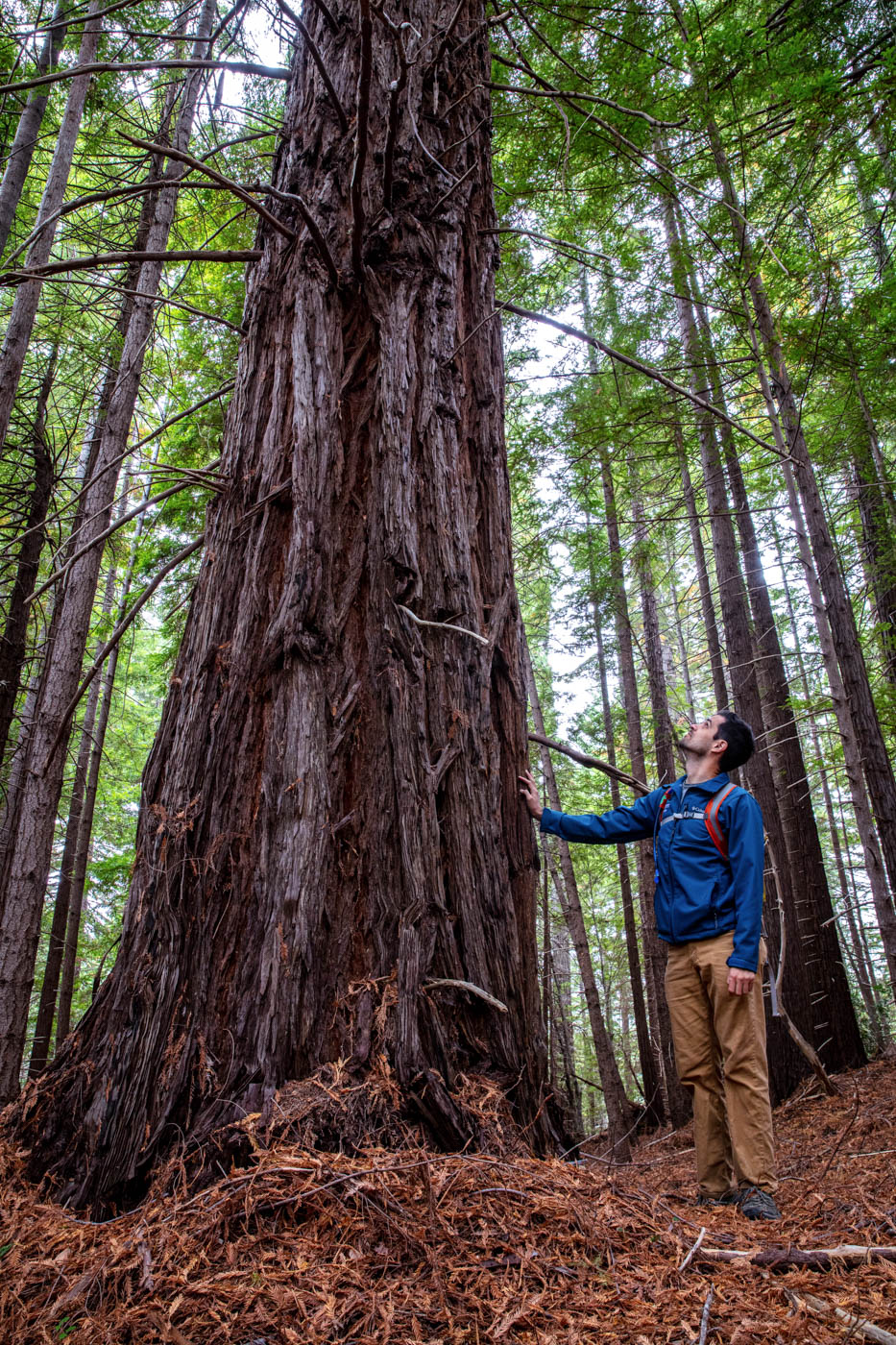
Save the Redwoods League holds a conservation easement for Tc’ih-Léh-Dûñ and will steward the property in partnership with the InterTribal Sinkyone Wilderness Council. Photo by Max Forster.
Newsroom
PRESS RELEASES
- January 25, 2022 — Save the Redwoods League Donates 523 Acres of Forestland to the InterTribal Sinkyone Wilderness Council for Lasting Protection
- July 29, 2020 — Save the Redwoods League Protects Andersonia West in Mendocino Redwoods, Along the Lost Coast
IN THE NEWS
- Redwood Forest in California Is Returned to Native Tribes
—The New York Times, January 2022 - California redwood forest returned to Native American tribes
—Associated Press, January 2022 - ‘An important victory’: Native American Tribes reclaim a redwood forest in Northern California
—San Francisco Chronicle, January 2022