Redwoods Rising is a collaboration among Save the Redwoods League, the National Park Service, and California State Parks.
Redwoods Rising unites Save the Redwoods League, California State Parks, and the National Park Service to restore these previously logged forests, protect the parks’ remaining old growth, and ensure the long-term health of these magnificent trees and all the plants, animals, and people who depend on them. By partnering, we can work at the pace and scale necessary to restore more than 70,000 acres of previously logged forests and reconnect 40,000 remaining acres of old-growth redwood forests in Redwood National and State Parks.
Together with redwood enthusiasts, park visitors, local communities, and Tribes, we will bring back the vibrant forests of redwood giants that once blanketed these lands.
Initial conversations about Redwoods Rising began in 2016, but the Memorandum of Understanding (MOU) that officially formalized the collaborative was signed on April 27, 2018. Project implementation began in 2020.
The complexity and costs of restoration continue to increase, making the need for coordinated and efficient project planning, execution, and funding more critical than ever. Scaling up and accelerating the pace of restoration activities across state and federal boundaries is also necessary if these fragmented ecosystems are to be resilient to the harmful impacts of drought, fire, disease, invasive species, and climate change.
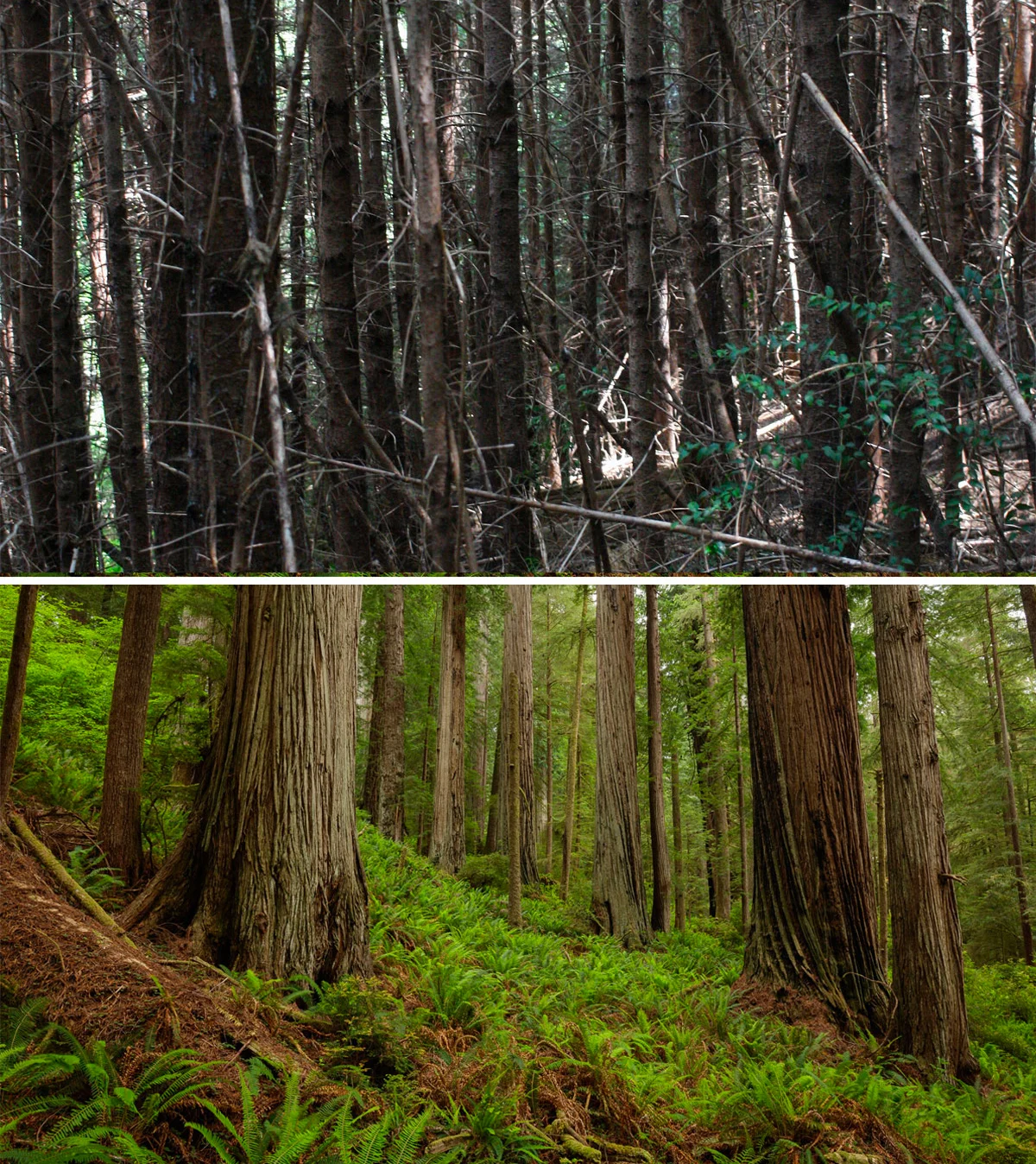
Before its protection as part of Redwood National and State Parks, this section of Mill Creek forest (TOP) was clear-cut and heavily reseeded. The result is an unnaturally dense stand struggling for light and water, largely devoid of wildlife and other plants. Redwoods Rising is healing these damaged forests so they can become like the parks’ ancient stands (BOTTOM), which are rich in flora and fauna.
The three collaborating organizations are providing funds and staff time for surveys, planning, compliance, project management, communication and outreach, and implementation. Individual donors, foundations, and public and private grant funds will also help increase agency capacity and accelerate the pace of restoration efforts.
We are working towards our goal to rehabilitate over 70,000 acres of second-growth forest in Redwood National and State Parks and remove 300 miles of abandoned, failing, and inaccessible roads in the next 30+ years. We are also continuously building capacity for greater collaboration and enhanced restoration of redwood ecosystems within the Prairie Creek and Mill Creek Watersheds.
Such significant damage was done to the landscape that in many cases natural processes like hydrology, erosion and plant regrowth no longer function the way they would need in order to recover on their own in the foreseeable future. If left alone, these ecosystems would likely continue to deteriorate for a long time before they could even begin to recover—putting the plant and animal species that depend upon them at great risk.
Furthermore, fierce competition for light among second-growth trees has led to stands of tall, skinny trees of similar age that are vulnerable to being easily knocked down by wind, rain or snow. In some cases, exotic tree species were planted or aerial seeded following logging operations further altering forest composition.
The goal of Redwoods Rising is to undo this damage to fast-track the development of healthy redwood forests. While it takes hundreds of years for an old-growth forest to form, the techniques being used here can set the restored areas on an accelerated trajectory towards old-growth conditions. Some qualities such as a diverse understory and shelter for wildlife can be created within decades, while other features like complex canopies, fire scars, and very large trees can take much longer to achieve.