
DAVENPORT, Calif. (September 13, 2023) — Leaders from the Peninsula Open Space Trust (POST) and Sempervirens Fund, who co-own and manage the 8,852 acres of San Vicente Redwoods (SVR), gathered last month with their partners Save the Redwoods League and Land Trust of Santa Cruz County to review their joint progress in advancing restoration of the property that burned completely in the CZU Lightning Complex wildfire of 2020. Their work has aimed both to restore the health of a forest that was heavily logged at the beginning of the 20th century, as well as to build wildfire resilience back into the regional landscape as part of CAL FIRE’s Community Wildfire Protection Plan for San Mateo and Santa Cruz counties. The partners’ work on the property has also aimed to benefit adjacent communities through infrastructure improvements and safety measures.
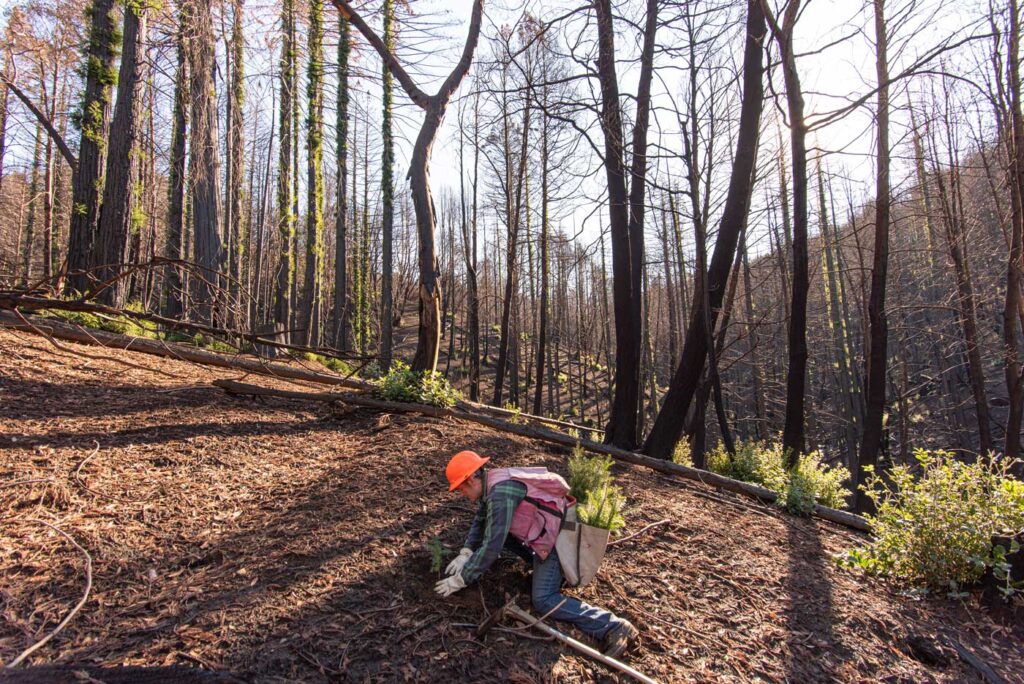
Redwood and mixed fir seedlings were planted across burned areas of San Vicente Redwoods. Photo: Matt Dolkas/POST.
Since early 2022 — 12 years into their unique co-management of this property — the SVR partners have treated more than 820 forested acres, roughly 10% of the property, using a variety of forest restoration techniques including removal of hazard trees along critical infrastructure (like roads and powerlines) and restoration thinning to encourage maturation of redwoods. The partners tended thousands of redwood and mixed fir seedlings planted last year across 270 acres of San Vicente Redwoods to accelerate the regrowth of the forest that burned in the CZU wildfire. Crews also cleared 5.7 miles of roads that had been blocked by aggressive post-CZU understory plant growth, restoring management access to the Coast-Cotoni Ridge.
Crews at SVR are creating nine miles of shaded fuel breaks along Warrenella Road that will help to slow future wildfires and protect nearby communities such as Davenport and Bonny Doon. Warrenella Road runs along a key ridgeline and was used by CAL FIRE to slow the 2009 Lockheed Fire. A total of 8,000 tons of biomass were removed from the forest in related efforts led by the Bonny Doon Fire Safe Council. All were incinerated on-site utilizing air curtain burners provided by CAL FIRE, which significantly reduce the release of both airborne pollutants and sparks — and the risk each carries.
The 2022-23 winter storm season brought an exceptional 75.15 inches of rain and multiple bomb cyclones through the property. Nevertheless, the team ensured that improvements to nine creek crossings on Cal Poly Road held up. These improvements reduced sedimentation along three miles of the environmentally sensitive Scott Creek watershed. Additionally, the driving surface of a bridge over San Vicente Creek, heavily damaged in the CZU fire, was repaired with redwood cut during fuels management efforts and milled on the property.
As a “living laboratory” for forest restoration and natural resource management, SVR hosts 24 researchers from 11 institutions, who are engaged in ongoing studies about the region’s sensitive resources, long-term impacts of and recovery from the CZU fire and the efficacy of restoration techniques. A botanical study revealed nine special status species and four locally rare species across 23 biological hotspots at SVR. These findings will help SVR partners target future restoration activities, like invasive plant management and ecologically focused prescribed burns. With support from the Amah Mutsun Land Trust’s Native Stewards, University of California Santa Cruz and National Oceanic and Atmospheric Administration researchers also confirmed the presence of rare coho salmon further into the property than ever noted before, swimming through a stream that was reopened to the ocean after a 2021 dam removal.
SVR partners performed repairs on storm-impacted roads to ensure that Davenport Sanitation District can access critical water infrastructure to support their customers. The partners also installed six new water tanks at three locations on the property to support emergency fire suppression for the region and maintenance operations on the property.
Additionally, the partners have engaged local partners and civic organizations in numerous ways, including hosting trainings for the Sheriff’s search and rescue crews; CAL FIRE chainsaw-use training and certification classes; and hose-laying training for the Bonny Doon volunteer fire-fighting team.
“Despite the CZU fire, San Vicente Redwoods is a case study in the promise of active, science-centered stewardship,” added Sara Barth, executive director of Sempervirens Fund. “We are succeeding, and it would not be possible without our ongoing partnerships, including with CAL FIRE, the Amah Mutsun Land Trust and the many state and regional agencies who are actively supporting and participating in the work.”
The partners built and opened 7.3 miles of hiking, biking and equestrian trails in December 2022, the first of several phases envisioned for the property. To date, more than 5,000 people have registered for a free lifetime pass issued by the Land Trust of Santa Cruz County to use the trails at San Vicente Redwoods.
The many types of work happening at SVR are both important and costly. In the past year, the partners and their property manager have secured $3 million in new grants and project-specific donations to ensure that the project continues uninterrupted. The funding sources include CAL FIRE, California Coastal Conservancy, Regional Water Quality Control Board, U.S. Natural Resource Conservation Service, Board of Forestry and numerous private and individual donors.
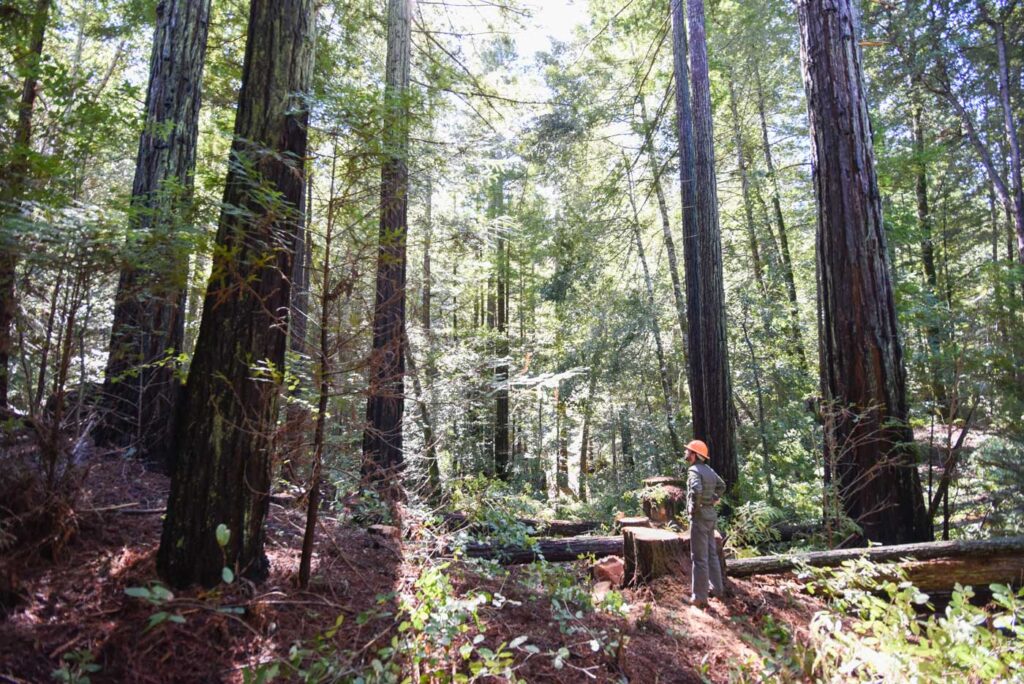
Selective restoration thinning at SVR. Photo: Matt Dolkas/POST
What’s Next at San Vicente Redwoods
In addition to continuing to create shaded fuel breaks and reduce fuels across the property, the partners are preparing for a conservation-focused commercial redwood timber harvest on 205 acres of the working forest section of the property. This innovative timber harvest is aimed at helping the forest recover from the CZU Fire by removing the smallest trees which were most impacted by the fire. By removing these severely damaged smaller redwoods, the remaining larger, healthier redwoods will have more space to thrive and recover from the fire damage. Partners expect these trees will continue to grow around damaged tissues, sequestering more carbon and creating crevices in the bark used by bats and other wildlife.
“Our conservation approach to harvesting is innovative and experimental compared to common practice, where we’re taking out the smallest trees rather than the larger ones,” explained Susan Petrie, senior stewardship project manager at POST. Any revenue generated by the harvest will go back into funding the ongoing restoration work at SVR.
Petrie added, “Even the harvest is part of our living laboratory approach at San Vicente Redwoods. Thanks to a Board of Forestry grant, we are tracking individual fire-damaged trees through the milling process to understand how external fire damage corresponds to internal wood condition. This knowledge will help foresters make more informed decisions about post-fire recovery and tree selection in the future throughout the redwood range.”
About San Vicente Redwoods
The 8,852-acre San Vicente Redwoods property near Santa Cruz, CA, is a model “living laboratory” of environmental conservation and collaboration. Most of the area was permanently protected by the nonprofit conservation partners in 2011, after intensive commercial logging at the beginning of the 20th century left much of the forest unhealthy. Peninsula Open Space Trust (POST) and Sempervirens Fund jointly own and actively manage the property. Save the Redwoods League holds a permanent conservation easement that ensures ecologically sensitive land management practices, as well as sustainable harvesting in the working forest areas of the property. Land Trust of Santa Cruz County developed and manages the property’s 7.3-mile public access trail system.

POST protects open space on the Peninsula and in the South Bay for the benefit of all. As a private nonprofit land trust, POST has been responsible for conserving more than 80,000 acres since its founding in 1977. POST works with private landowners and public agencies to connect people and nature. Visit openspacetrust.org for more information.

California’s first land trust, Sempervirens Fund protects and permanently preserves redwood (Sequoia sempervirens) forests, wildlife habitat, watersheds, and other important natural and scenic features of the Santa Cruz Mountains and encourages public appreciation and enjoyment of this environment. sempervirens.org

The mission of the Land Trust of Santa Cruz County is to protect, care for, and connect people to the extraordinary lands that make this area special. Information is available at LandTrustSantaCruz.org.

Save the Redwoods League revitalizes coast redwood and giant sequoia forests across California’s redwood range. In partnership with state and federal agencies, Tribes, and communities, we have conserved more than 220,000 acres in 76 parks and preserves and restored 37,000 acres. Our work bolsters carbon storage, strengthens wildfire resilience, benefits local economies, and safeguards iconic landscapes enjoyed by millions.