
July 9, 2026
As America marked its 250th birthday, ABC News’ Wonders of America took viewers on a tour of the country’s greatest natural treasures—with redwoods as the final, awe-inspiring reveal. Is it any, ahem, wonder why? Towering to dizzying heights and living for millennia, these trees hold a special place in the American imagination and embody the wild, otherworldly beauty of Northern California.
The coast redwoods segment introduced viewers to Save the Redwoods League experts and conservation partners (not to mention a curious herd of Roosevelt elk) working on the ground to restore and protect the coast redwood forests, from Redwoods Rising restoration sites to the newly transformed ‘O Rew Redwoods Gateway.
Inspired by redwoods’ selection as one of America’s seven natural wonders, we put together a list of seven reasons they’re worthy of the honor. Though we could have listed 70. Or 700.
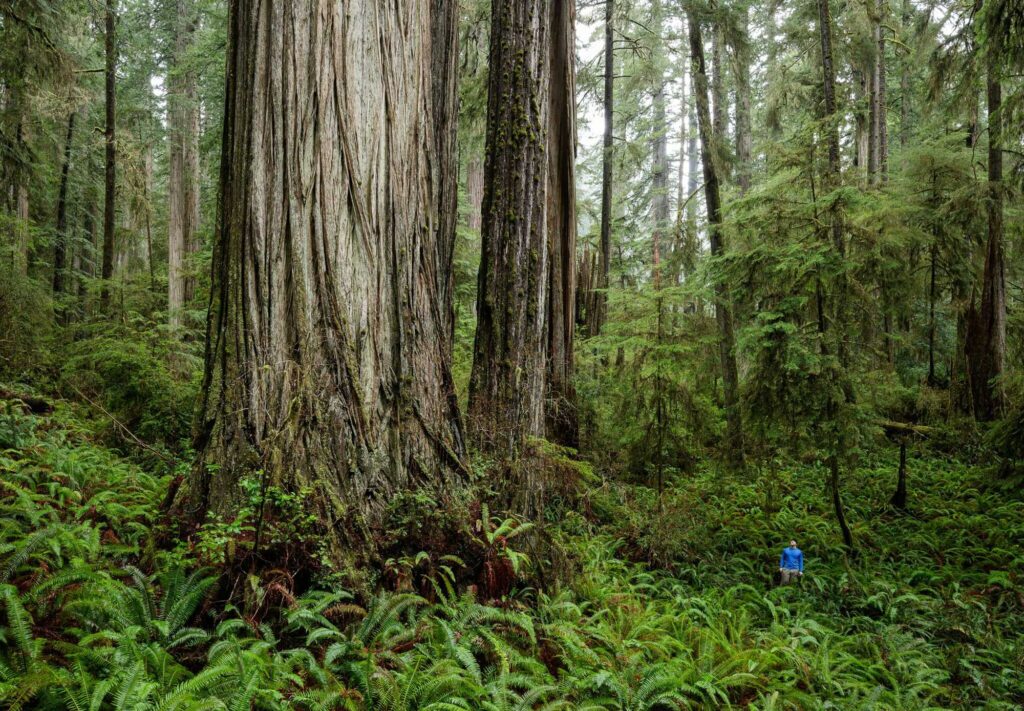
With their unfathomable heights, the redwoods connect us to something larger than ourselves. Photo by Max Forster.
1) They’re almost inconceivably big
Old-growth coast redwoods are the tallest trees on the planet. They regularly top 300 feet but can grow much taller. Hyperion, the tallest known living tree on Earth, scrapes the sky at roughly 380 feet—75 feet higher than the Statue of Liberty. And there are hundreds of coast redwoods that top 350 feet. Standing at the base of one of Hyperion’s colossal redwood friends, you’ll learn how awe can be a full-body experience.
2) They can drink fog
Though a thick marine layer might ruin your beach trip, coast redwoods love it. They’re masters of making the most of a foggy day. During California’s drier summer months, coast redwoods absorb water directly from the fog that drifts through their leaves—they can get as much as a third of their moisture this way. The fog they don’t drink drips down as a kind of rain, nourishing the surrounding forest.
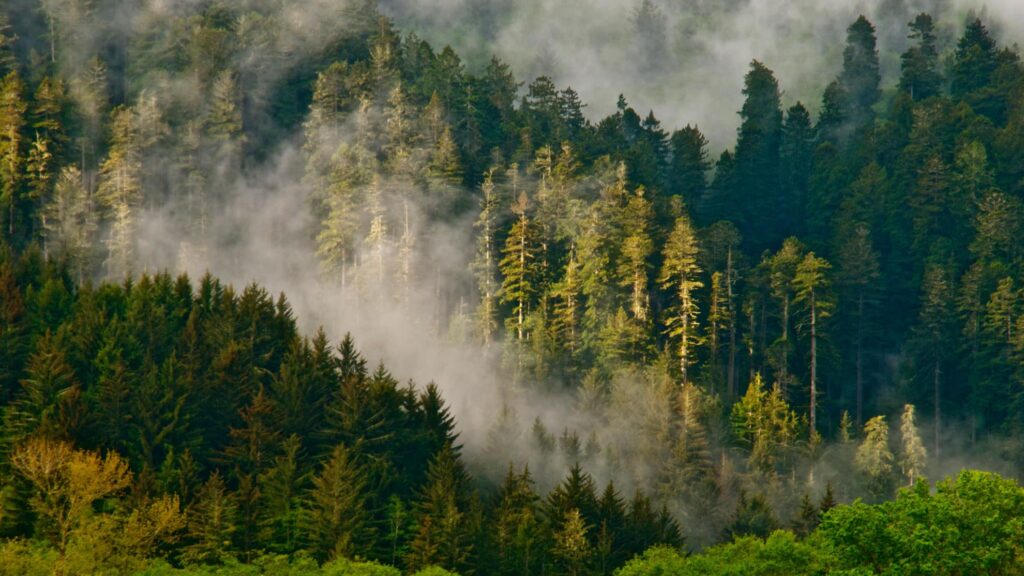
Fog drifts in over Redwood National Park. Photo by Jon Parmentier.
3) They store immense amounts of carbon
Redwoods are among our greatest allies in a warming world. Old-growth coast redwoods absorb massive amounts of carbon dioxide and lock it away in their wood, storing more carbon per acre than any other forest on Earth—even the Amazon rainforest. As we work to protect these remarkable trees, they help protect our future in return.
4) They are resilient in the face of wildfire
Protected by bark that can be a foot thick, coast redwoods are uniquely well adapted to fire. Ancient giants are often blackened with the scars of fires they survived centuries ago, and even after burning, they can resprout new branches from buds that have been dormant for centuries. Still, megafires can breach these defenses, reminding us that even the most resilient forests are not invulnerable.
5) They’re habitat providers
Coast redwoods anchor forests that provide habitat for hundreds of species, including threatened and endangered wildlife like coho salmon, northern spotted owls, and marbled murrelets. Though murrelets are primarily sea birds, they’ll fly up to 50 miles inland to find an old-growth redwood where they can lay their eggs. We don’t blame them one bit.
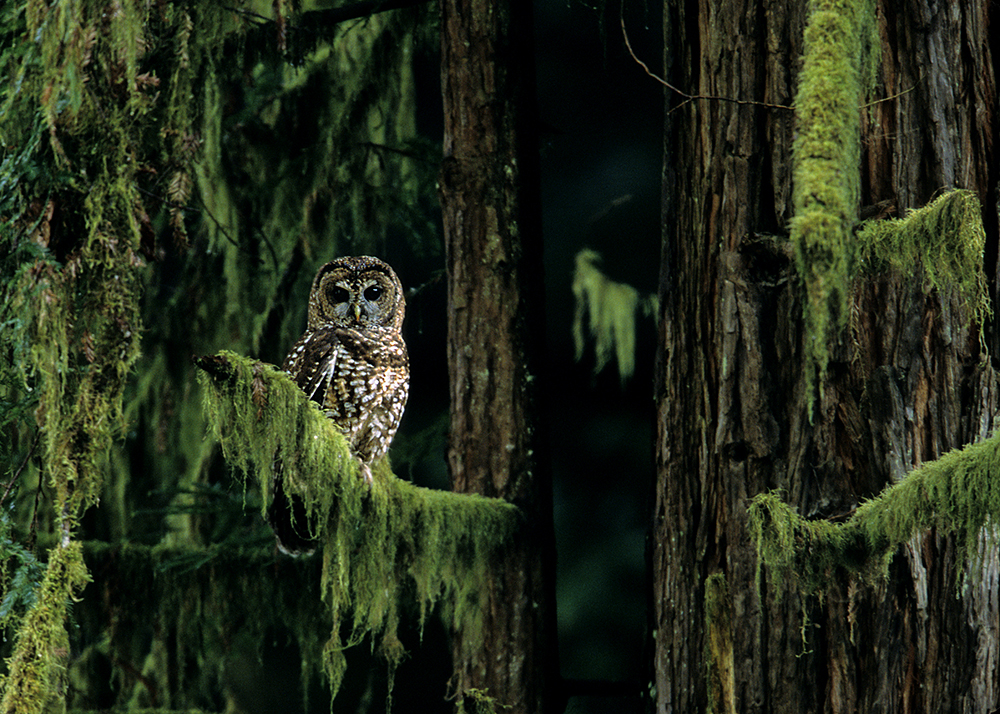
Northern spotted owls are threatened by habitat loss and competition from invasive barred owls. Photo by Alan Justice.
6) They can survive for millennia
A redwood that sprouted around the time the Declaration of Independence was signed would still be relatively young by redwood standards. Protected by fire-resistant bark, tannins that fend off pests and decay, and interconnected roots that support neighboring trees, redwoods can live for more than 2,000 years. Some of the giants standing today were already ancient in 1776.
7) They’re basically living apartment buildings
There are entire worlds suspended high up in coast redwood canopies. Fern mats the size of cars, filled with rich soil and water, grow suspended on massive branches. These mats support an astonishing array of plants and animals that never set foot—or root—on the ground. Incredibly, entirely different species of trees can sometimes be found growing from the branches of truly massive old-growth coast redwoods.

4 Responses to "7 reasons redwoods are one of America’s natural wonders"
The Empire State Building is 1250′ high not counting the antenna. The maximum possible height of a Redwood is 420 feet due to the physics of gravity. So as magnificent as the coastal Redwoods are the Empire State Building is much taller.
Thanks Martin-you’re right. The Empire State Building is 380 meters tall, and I got my feet mixed up with my meters. I’m a forest guy, not a city guy, and believe it or not, I’ve never seen the Empire State Building in person—I had no idea it was that tall. Over three Hyperions!
I watched this great story on ABC News. Congrats to the League and our expert spokesperson, who did a terrific job setting the scene.
I have been privileged to have been able to visit the Redwoods. They are magnificent to visit and walk amongst. Reading this information is amazing to learn about the resilience of these amazing trees. Walking in the Redwood forests it seems almost as though you should not even talk. Just listening to the sounds of the forest makes it seem as though you should whisper if you are going to talk. I can “feel” the energy of the forest and it seems almost as though I can feel them whispering in the winds. It is almost a religious experience to be able to feel the energy radiating amongst them. I feel like I should whisper like I’m in a Cathedral.