
Save the Redwoods League revitalizes coast redwood and giant sequoia forests across California’s redwood range. In partnership with state and federal agencies, Tribes, and communities, we have conserved more than 220,000 acres in 76 parks and preserves and restored 37,000 acres. Our work bolsters carbon storage, strengthens wildfire resilience, benefits local economies, and safeguards iconic landscapes enjoyed by millions.
April 16, 2018
San Francisco, Calif. (April 16, 2018) – Save the Redwoods League (League), the National Park Service (NPS) and California State Parks (State Parks) today announced a new commitment to heal previously-harvested redwood forests through a collaboration known as Redwoods Rising. One of the goals in the coming decades is to bring back stands of towering coast redwoods (Sequoia sempervirens) on 80,000 acres of public lands in Redwood National and State Parks (RNSP). Redwoods Rising creates an unprecedented level of collaboration between these three organizations to restore the redwood forests and ensure the parks’ entire 120,000 acres exist as a connected forest ecosystem and a thriving landscape that supports and protects the natural and cultural treasures found there.
“If our greatest responsibility is to leave the world better than we found it, then healing the redwood forest represents an opportunity of a lifetime. We can actually restore and grow the old-growth forests of the future,” said Sam Hodder, president and CEO of Save the Redwoods League. “We have the tools and the will, and thanks to our generous donors and our national and state park partners, we are taking a major step forward toward leaving California better than we found it.”
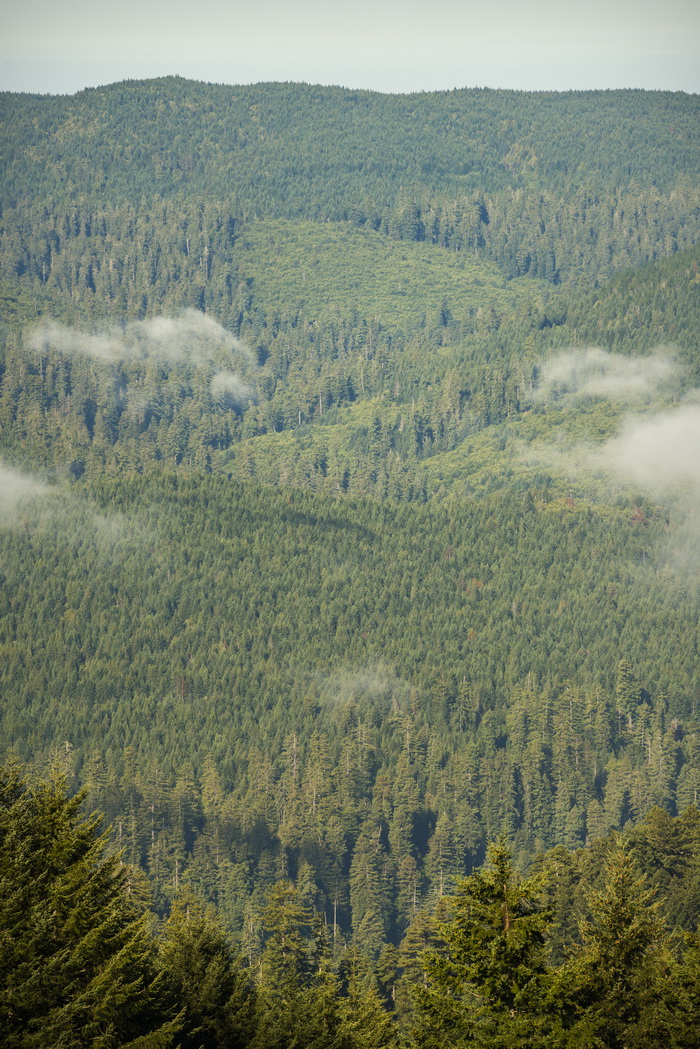
Residual old-growth redwoods rise above a forest that was logged before the area in the Redwood Creek watershed became part of Redwood National and State Parks. Photo by Mike Shoys
Located 325 miles north of San Francisco, Redwood National and State Parks are a UNESCO World Heritage site comprised of Redwood National Park, and Prairie Creek Redwoods, Del Norte Coast Redwoods, and Jedediah Smith Redwoods State Parks. The parks are home to 45 percent of the world’s remaining protected old-growth redwoods and half of the world’s tallest trees. However, surrounding the primeval redwood stands are large swaths of younger forest that were once heavily harvested. Old logging roads spread invasive species and erode sediment into nearby streams, threatening coho salmon and steelhead trout.
Benefits of Redwoods Rising
- Provides clean air and water
- Fights climate change
- Creates and restores wildlife habitat
- Begins to bring back the ancient redwoods for future generations to enjoy
- Leverages organizational strengths and expertise while increasing efficiency
- Provides a new opportunity for the public to support these forests directly
Coast redwood forests store more carbon per acre than any other forest on the planet — by at least three times. One of the exciting and environmentally important aspects of accelerating the growth of massive redwoods is that these trees are climate change fighters. So, as we restore the redwood forests, we increase their ability to absorb more carbon. Also, because the trees are so resistant to rot, they hold onto their carbon for a very long time even after they die. This is an effective, natural form of carbon sequestration.
“We are thrilled to collaborate with Save the Redwoods League and California State Parks,” said Steve Mietz, superintendent of Redwood National Park. “Redwoods Rising aligns the public and private sectors to take the next big steps towards restoring these cherished public landscapes. It is a great investment in our future.”
By 2022, the Redwoods Rising collaborative will conduct restoration forestry activities across 10,000 acres of the forested watersheds of Mill Creek and Prairie Creek within RNSP. These forests were clearcut prior to the parks’ establishment, and actively restoring them will reconnect precious remaining old-growth areas, improving habitat quality and resiliency.
“Now more than ever, we recognize that to protect our treasured redwoods, we must invest in the entire landscape,” said Lisa Mangat, director of California State Parks. “Our iconic redwoods provide for us in myriad ways — clean air and water, steelhead and salmon, and plentiful wildlife — just as they inspire us. With a bold initiative now, we can protect these ancient forests from the most extreme effects of climate change, and be confident that future Californians can enjoy their majesty.”
The League has already raised over $2.26 million towards the $5 million goal needed to fund initial projects, including support for the Forest Fellows program, which mentors the next generation of conservation foresters, and a $1 million grant from the S. D. Bechtel, Jr. Foundation. Going forward, Redwoods Rising collaborators will work together to cultivate new private philanthropic and public support for the project, with the League as lead and fiscal administrator.
“Our first priority must be our best places, the places where we have the most extensive stands of old trees,” says Emily Burns, science director for Save the Redwoods League. “Redwood National and State Parks are our greatest remaining reservoirs of redwood forest biodiversity. They contain the precious and irreplaceable components of the full, complete and healthy redwood ecosystem. It is our job to spread the ecological wealth of these ancient stands into surrounding lands.”
Please visit RedwoodsRising.org for additional information and opportunities to support this exciting new initiative.
Note to editors: a celebratory event is scheduled for Friday, April 27. Please contact Robin Carr, Landis Communications, Inc. at (415) 766-0927 or via email at [email protected] for event details or a helicopter tour.
Contacts:
- Save the Redwoods League: David Cumpston, Landis Communications, Inc.
Phone: (415) 359-2316 | Email: [email protected] - National Park Service: Leonel Arguello
Phone: (707) 465-7780 | Email: [email protected] - California State Parks: Gloria Sandoval
Phone: (916) 651-7661 | Email: [email protected]
To access hi-res images or b-roll of Redwood National and State Parks, view our media resources.

California State Parks and the recreational programs supported by its divisions of Boating and Waterways, Historic Preservation and Off-Highway Motor Vehicle Recreation provide the opportunity for families, friends and communities to connect. Off-highway motor vehicle recreation, boating activities, horseback riding, cycling, hiking, camping, rock climbing, tours, hikes, school group enrichment and special events are just some of the activities enjoyed in 280 park units organized into 21 field districts throughout the state. Learn more at www.parks.ca.gov.
National Park Service (NPS) preserves unimpaired the natural and cultural resources and values of the national park system for the enjoyment, education and inspiration of this and future generations. The national park system includes 419 areas covering more than 84 million acres in every state, the District of Columbia, American Samoa, Guam, Puerto Rico and the Virgin Islands. The NPS cooperates with partners to extend the benefits of natural and cultural resource conservation and outdoor recreation throughout this country and the world. Learn more at www.nps.gov.