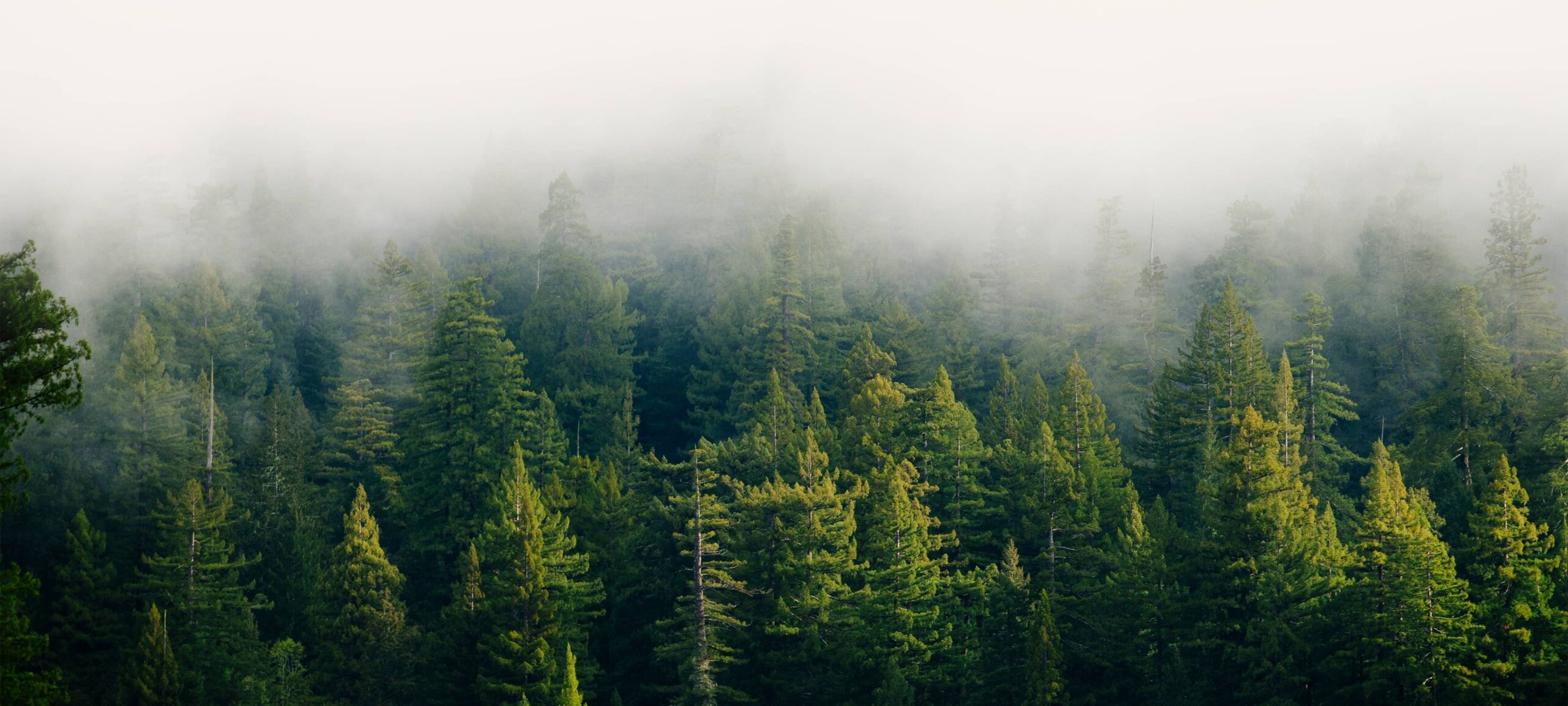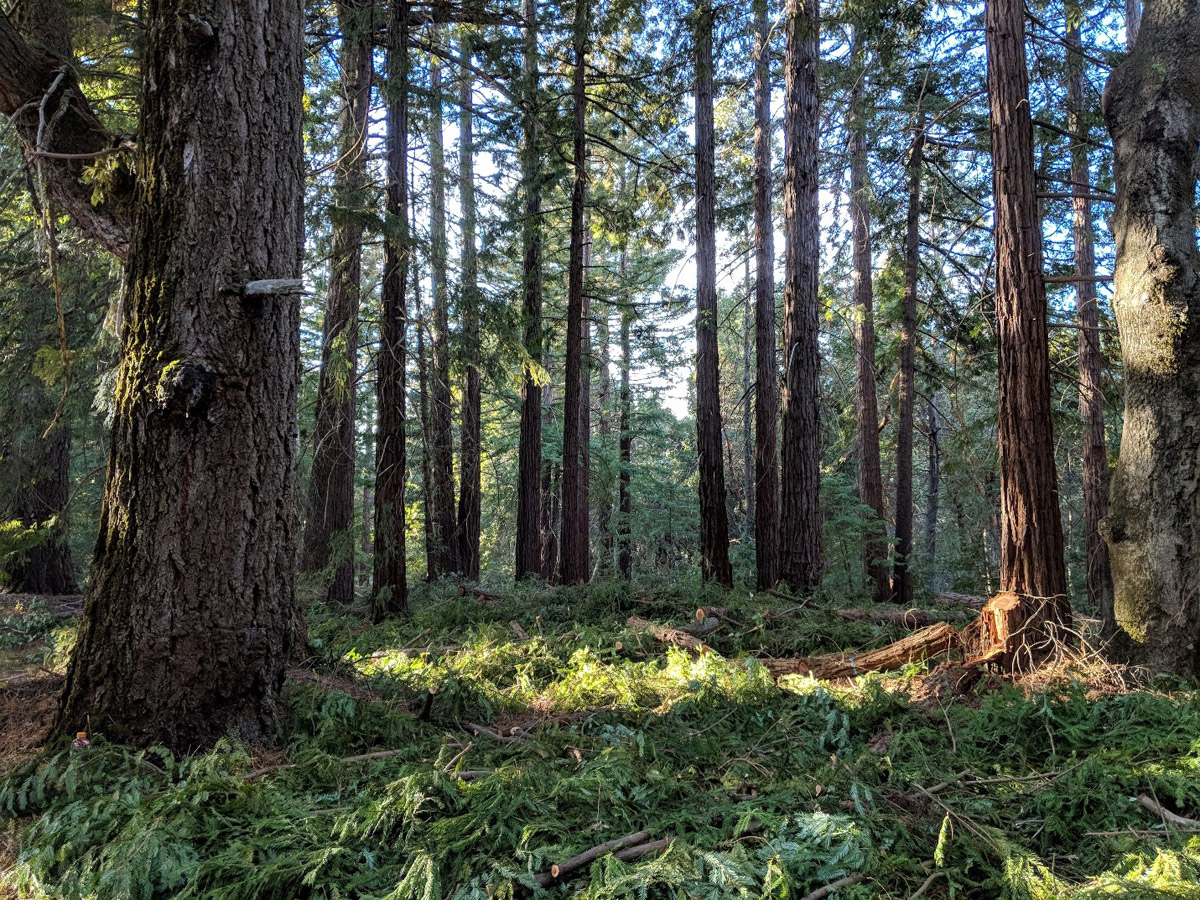
Northwest of Santa Cruz, where the mountains meet the Pacific coast, likes San Vicente Redwoods—a keystone property linking a larger 27,500-acre network of protected forest. Here, within the traditional lands of the Amah Mutsun Tribal Band, Muwekma Ohlone Tribe, and Awaswas People, ancient giants tower above a young forest recovering from industrial logging and wildfire. Mountain lions prowl the shaded hillsides and coho salmon swim through cool streams toward spawning grounds. And from the high ridgelines—accessible via new multiuse trails—the views reach all the way to the ocean.
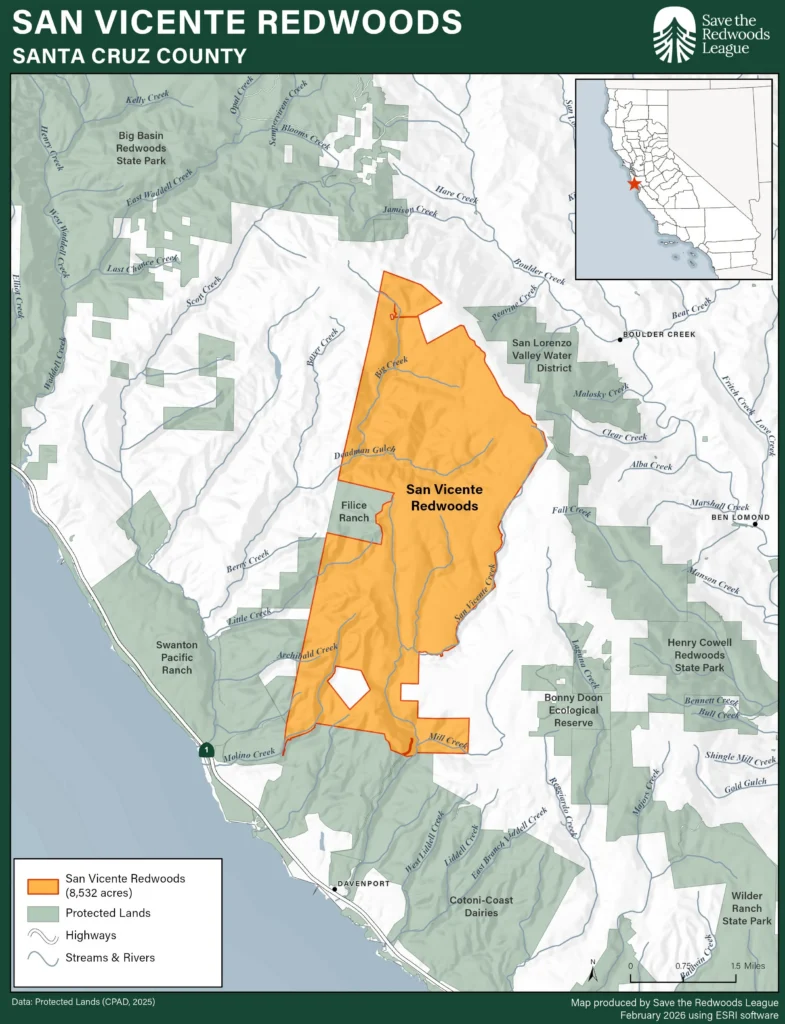
This 8,852-acre property is a model of environmental conservation and collaboration. In 2011, a partnership of Save the Redwoods, Peninsula Open Space Trust, Sempervirens Fund, Land Trust of Santa Cruz County, and The Nature Conservancy, stepped in to purchase the land before it could be subdivided and developed. Today, Peninsula Open Space Trust and Sempervirens Fund jointly own and manage the land, Save the Redwoods holds a conservation easement ensuring its permanent protection, and the Land Trust of Santa Cruz County manages public access. The Amah Mutsun Tribal Band and the Amah Mutsun Land Trust collaborate with the partners on stewardship, cultural fire, and restoration.
What we secured
- 8,852-acre property that connects 27,500 acres of contiguous protected woodland in the Santa Cruz Mountains
- At least 90 old-growth redwoods and a recovering forest on a path toward old-growth characteristics
- A living laboratory for wildfire resilience, where prescribed burns and fuel reduction are demonstrating measurable results
- More than 7 miles of public trails open for hiking and biking—the first phase of an envisioned 38-mile trail system
- Active Tribal stewardship of the traditional lands of the Amah Mutsun Tribal Band, Muwekma Ohlone Tribe, and Awaswas People
- Streams that support endangered wildlife and provide drinking water for Davenport and Santa Cruz
- Habitat for a variety of imperiled animals and plants, including the California red-legged frog, marbled murrelets, coho salmon, Shreve and Oracle oaks, and Anderson’s manzanita
A living laboratory
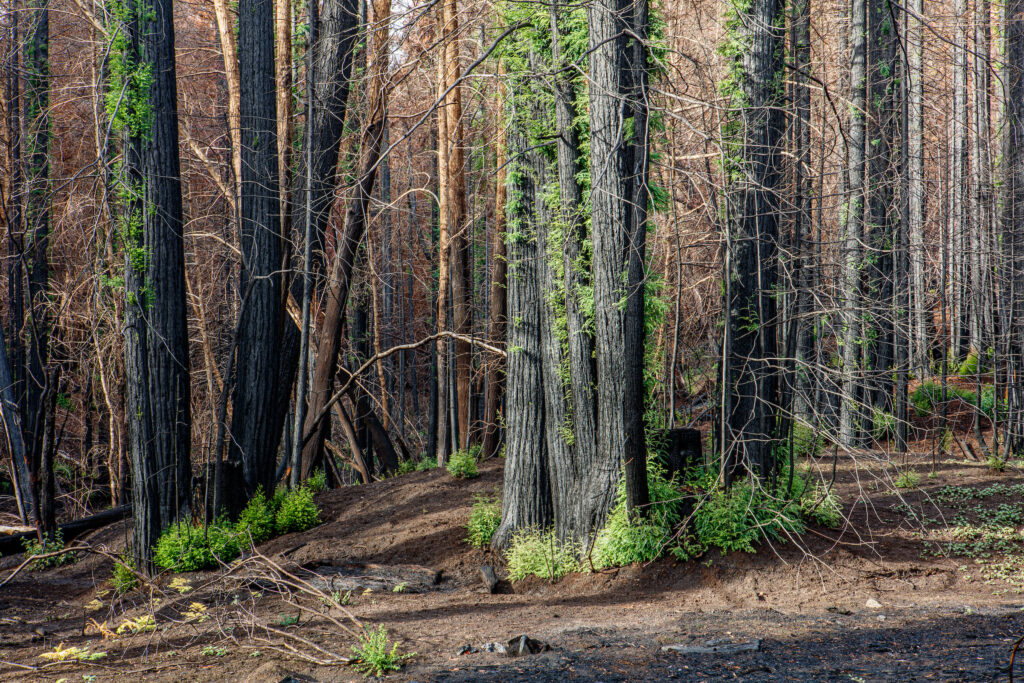
Coast redwoods in San Vicente are already resprouting after the forest burned in the CZU Lightning Complex fire. Photo by Ian Bornarth.
Since its protection in 2011, San Vicente Redwoods has served as a living laboratory for forest restoration—and the lessons learned here have only grown more urgent. Much of the property was clear-cut in decades past, leaving dense, overcrowded stands of young trees competing for light, water, and nutrients. These conditions make forests more susceptible to drought, disease, and severe wildfire. Restoring old-growth characteristics—big trees, open canopies, diverse understories—is both an ecological goal and a strategy for long-term resilience.
In August 2020, that strategy was put to the test. The CZU Lightning Complex fires burned across the entire property, killing most of the ancient Douglas-firs and many other hardwood trees. But the coast redwoods resprouted from their bases and canopies almost immediately. Native plants that hadn’t grown in the forest for years emerged from the ash, their dormant seeds germinated by the heat. Among other post-fire discoveries: the appearance of a fire-following perennial flower never before recorded in Santa Cruz County and an extremely rare annual herb not documented in the county since the mid-1950s.
Before the blaze, the partners had treated parts of the property using prescribed and cultural burns and created more than 15 miles of shaded fuel breaks. Those treated areas weathered the fire far better than adjacent overgrown parts of the property. Based on this ongoing research, Save the Redwoods has completed more than 650 acres of restoration work at the property’s Deadman Gulch Restoration Reserve to promote future wildfire resilience and accelerate the return of a mature forest.
Scientists continue to study the forest’s recovery, generating insights into how wildfire, restoration thinning, and prescribed fire interact. The lessons emerging from San Vicente Redwoods will inform forest management well beyond the Santa Cruz Mountains.
Watching wildlife thrive
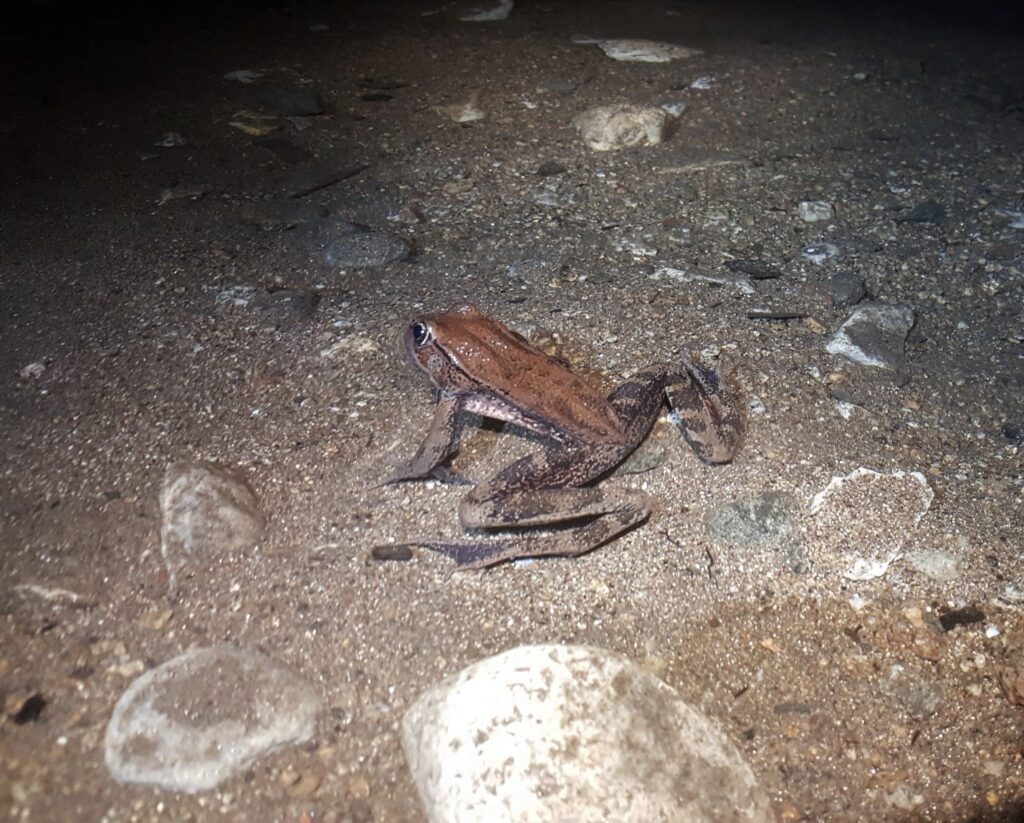
The threatened California red-legged frog in a cave on the San Vicente property. Photo by Mike Davies.
San Vicente Redwoods is a haven for a remarkable range of species, including coyotes, bobcats, pumas, peregrine falcons, and endangered California red-legged frogs. Our conservation partnership is working hard to help these species thrive.
Mountain lions are among the property’s most iconic and well researched residents. A collaboration with the Santa Cruz Puma Project has yielded significant data about how the wide-ranging cats use different areas of San Vicente Redwoods for communication, breeding, and denning.
In addition, audio sensors and motion-activated wildlife cameras track animal activity across the property. The Wildlife Picture Index project uses the cameras to monitor numerous species and study how they respond to human activity. Audio monitoring devices, installed in 2013, confirmed the presence of the endangered marbled murrelet at San Vicente Redwoods for the first time since 1914 and continue to track this elusive seabird, which nests exclusively in the crowns of old-growth trees.
The partners have also restored critical aquatic habitat. In 2019, crews placed logs in San Vicente Creek to create the pools endangered coho salmon, threatened steelhead trout, and other wildlife need. The 2021 dam removal on Mill Creek further opened miles of spawning habitat. And a multiyear effort to remove the invasive vine Clematis vitalba from San Vicente Creek is reestablishing equilibrium for insects, fish, and plants alike.
This ongoing habitat restoration and research will inform trail management and future development to ensure that needs are met for all—humans and wildlife—who inhabit and use the lands.
Trails with a view
At San Vicente Redwoods, conservation and recreation work in tandem. The partners plan to provide public access to 38 miles of trails, connecting millions of people in the Bay Area and surrounding communities to this remarkable landscape. In December 2022, the first 7.3 miles opened to hikers, mountain bikers, and equestrians. The trails offer sweeping views of the California coastline and a rare opportunity to witness a forest rebounding from clearcutting and recent wildfires.
The partners carefully balanced public access with their conservation objectives, using their years of wildlife behavior studies to inform trail placement and limited operating hours. The trails also serve a practical purpose: They double as part of a new fuel-break system designed to protect the surrounding community in future wildfires.
Deep roots, shared stewardship
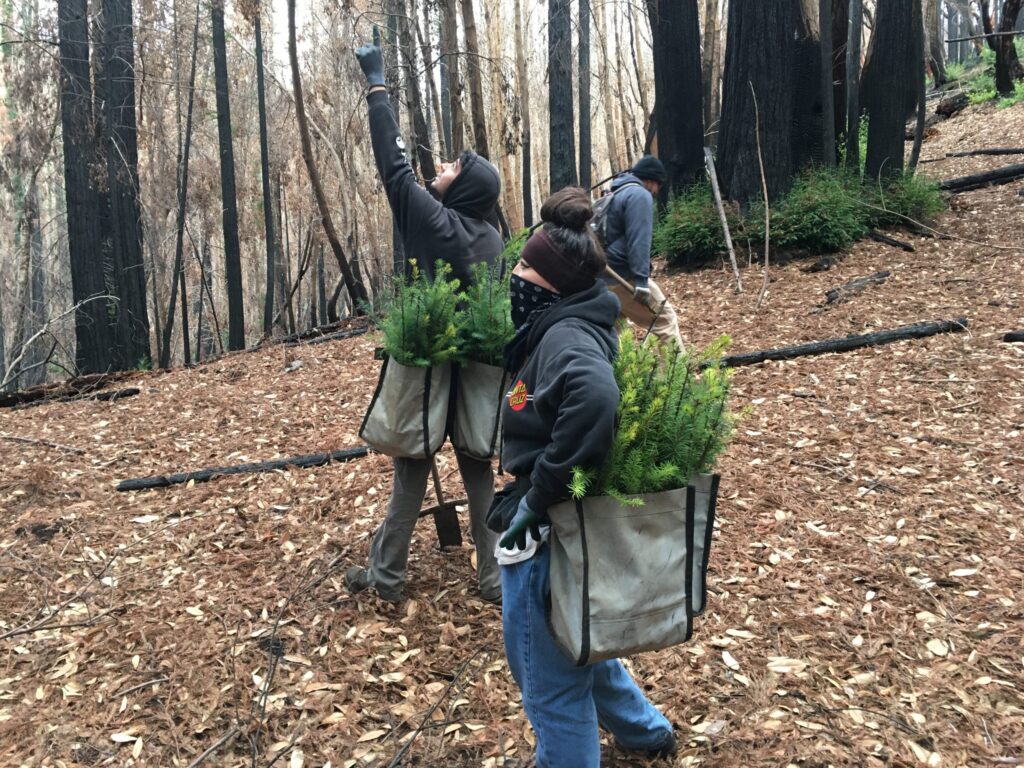
Crews planted coast redwood and Douglas-fir seedlings with the Amah Mutsun Land Trust. Photo by Anthony Castaños.
The Amah Mutsun Tribal Band and the Amah Mutsun Land Trust have long collaborated with the conservation partners, bringing Traditional Ecological Knowledge and cultural practices to San Vicente Redwoods’ stewardship.
In 2016, the Amah Mutsun Tribal Band reintroduced cultural fire to San Vicente Redwoods with the first ceremonial burn in more than 200 years—a milestone in the restoration of Indigenous land management practices. More recently, Tribal members worked alongside Save the Redwoods and Peninsula Open Space Trust to plant 5,500 seedlings in the Deadman Gulch Restoration Reserve and Working Forest unit.
Collaborative research has led to culturally significant discoveries, including evidence of frequent past land use and plants cultivated by Indigenous people, suggesting that San Vicente Redwoods was among their seasonal homes. A forest health survey led by UC Berkeley scientists and the Amah Mutsun Tribal Band studied how the CZU fire impacted native plant species.
The property’s new public trails are named in the Awaswas language, honoring the people who inhabited and cared for these lands for millennia. It’s a fitting reflection of a project where past and present come together in the service of a healthier future.
Stronger together
Our partnership has secured a vast, connected landscape in the Santa Cruz Mountains—one that shelters endangered species, provides clean drinking water for local communities, advances the science of wildfire resilience, and now welcomes visitors to more than 7 miles of trails, with plans for many more.
The work is far from finished. Restoration will continue for years to come, guided by science, strengthened by Tribal collaboration, and shaped by the lessons of fire. But the foundation is in place—and the forest is already responding. Together, we are building a future where these redwoods will stand tall for generations.
Newsroom
PRESS RELEASES
- September 2, 2022 — Land Trust of Santa Cruz County and Partners to Open First Phase of New Public Trails at San Vicente Redwoods
- March 9, 2022 — Construction to Begin on Public Access Trail System at San Vicente Redwoods, Following CZ Wildfire and Pandemic Delays
IN THE NEWS
- San Vicente Redwoods, a Forest Reborn, Opens After a Century Off-Limits
–Bay Nature, January 2023 - San Vicente Redwoods in Santa Cruz County is tribute to wildfire resilience
–SF Gate, January 2023 - Large number of trails opening in Santa Cruz Mountains, thanks to conservation work
–San Francisco Chronicle, November 2022