October 16, 2026
Most visitors to a redwood forest find themselves enchanted by the mighty trees. But some of the forest’s strangest wonders are much, much smaller: the diminutive lichens.
Part fungus, part . . . something else, and more complex than they might seem, these remarkable little organisms quietly sustain redwood forests and help entire communities of plants take root hundreds of feet above the ground.
And this is a great time to go hunting for them. As fall storms send lichens tumbling from the canopy, we get the rare chance to see their incredible array of colors and shapes, offering a close-up look at inhabitants of a world normally hidden far overhead.
An ecosystem unto themselves
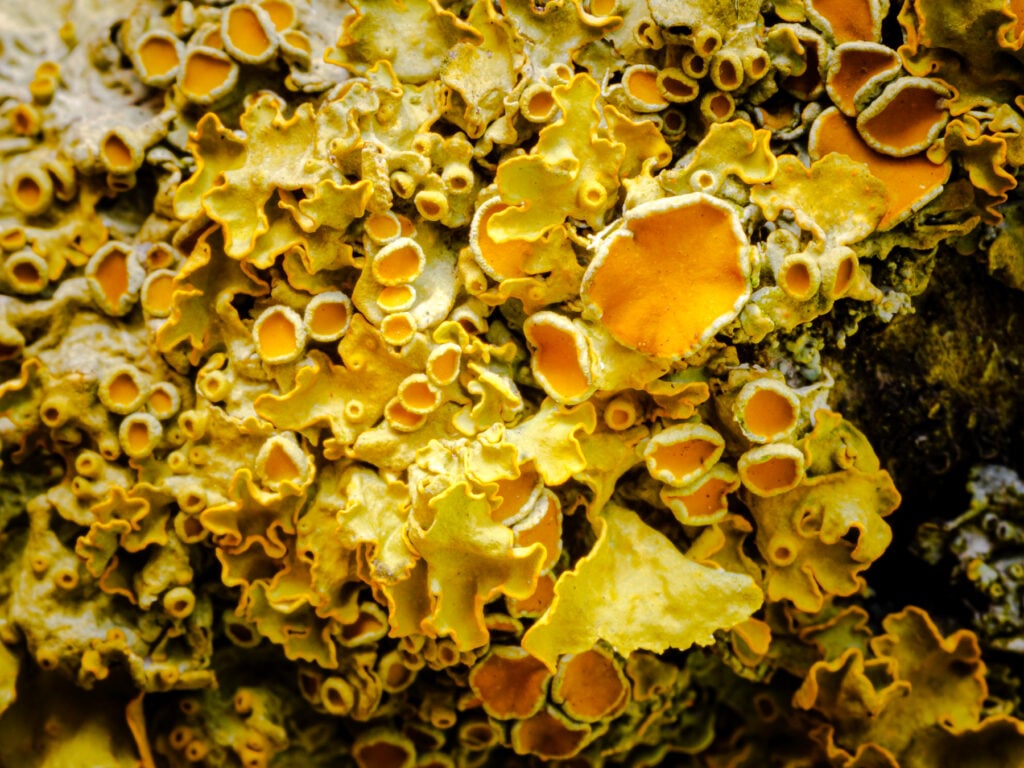
The word “symbiosis” was originally coined by a German botanist to describe the partnership between fungi and algae in lichens—like this sunburst lichen. Photo by Anthony Speca.
Basically, lichens are a partnership between fungi and other organisms that get their energy from the sun.
Until about a decade ago, scientists thought lichens were simple partnerships between a single fungus and sun-powered organisms like algae or certain bacteria. The fungus provided structure and protection while its partners supplied the fungus with food from sunlight. Modern molecular tools have since revealed more of the tiny, complicated world of lichens.
A recent study in Current Biology highlights just how complex lichens can be. Researchers found as many as 168 organisms in the common sunburst lichen, including distantly related fungi, algae, and bacteria. Yet, the sunburst lichen reproduces and can rebuild itself in nature, sometimes even picking up a photosynthetic partner from another lichen. We now see lichens not as simple partnerships, but miniature ecosystems.
Oh, the amazing things they do
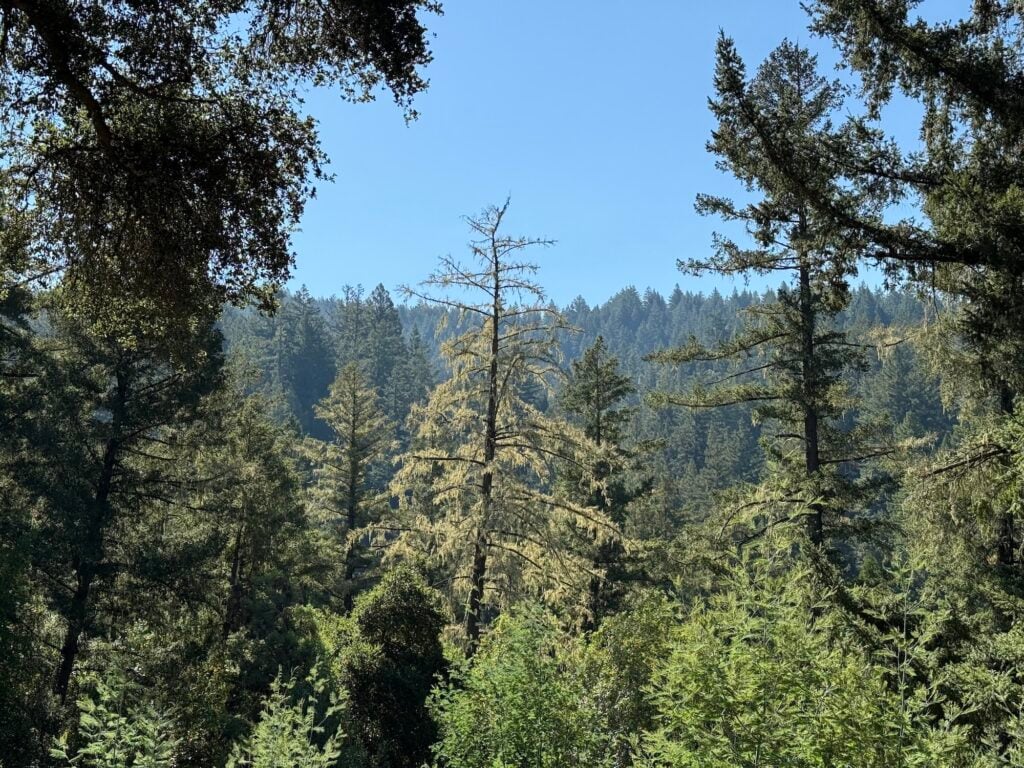
Look closer—what appear to be leaves on the tree rising in the center of this forest in the Santa Cruz Mountains are actually lichens draped over the branches. Photo by Famartin/Wikimedia.
At first glance, lichens may seem like minor players in the redwood forest, clinging inconspicuously to trees, rocks, or the ground. Yet, despite their small stature, lichens fill foundational roles in the redwoods ecosystem.
Unlike most plants, which draw nutrients from the soil, lichens get theirs directly from the atmosphere. This unusual ability helps them bring nutrients into the forest surrounding them.
For example, some lichens can directly convert (or “fix”) atmospheric nitrogen into a form other living organisms can use. In mature redwood forests, these lichens introduce much of the new nitrogen that redwoods and other plants need to grow and thrive. In fact, their ability to provide nutrients that fuel other plants inspired lichenologist Trevor Goward to say lichens are “fungi that have discovered agriculture.”
But that’s not their only contribution.
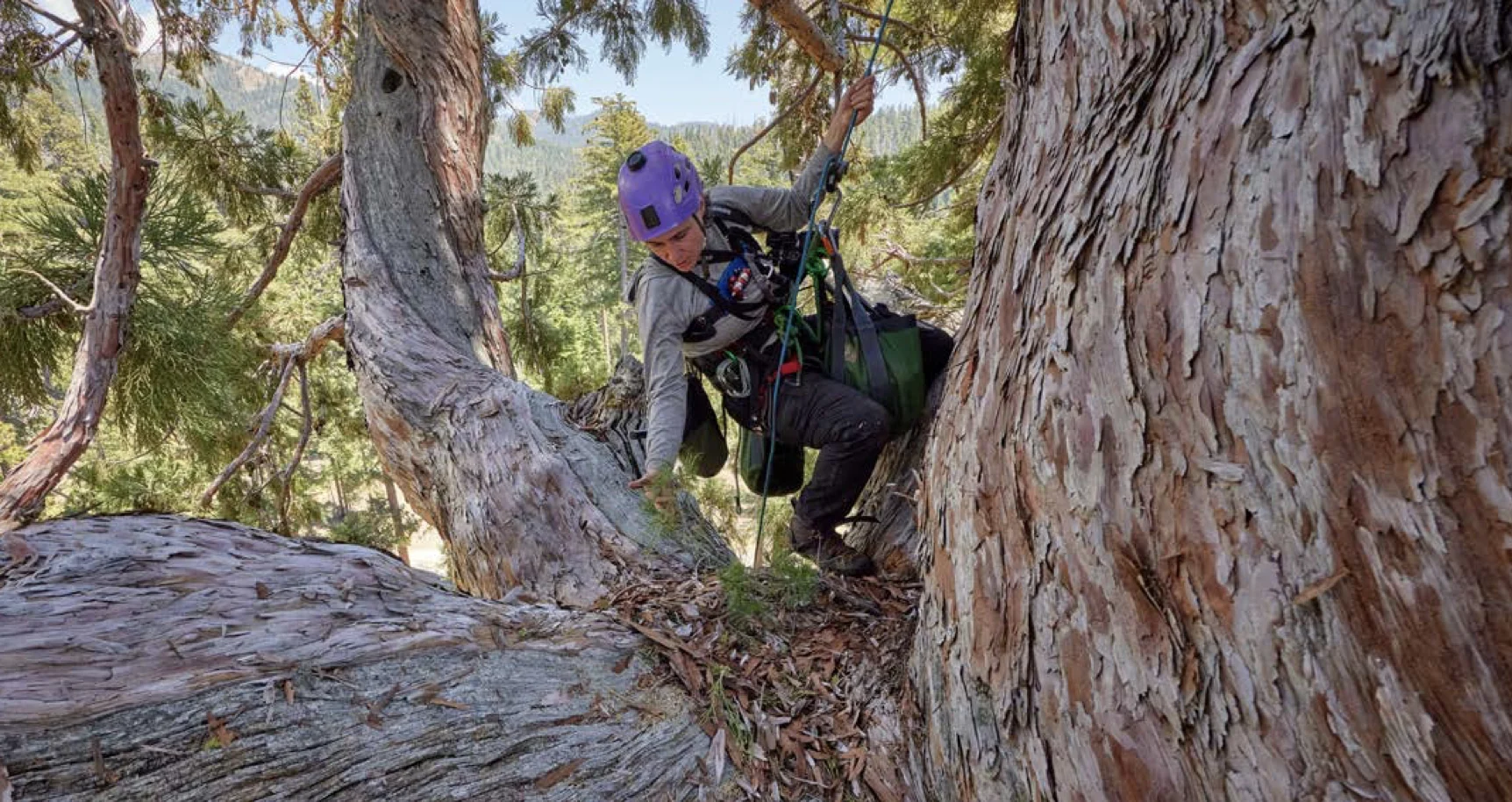
Lichens are also crucial for the communities that grow high above the ground in mature redwood canopies. Because they can get all their nourishment from the air, lichens are among the first organisms to settle on new canopy growth. Over time, lichen communities create the moist conditions that spur the growth of mosses. Lichens and mosses then mix with bark, twigs, and needles collected in nooks and crannies, eventually breaking down into soil. This soil allows plants to grow high in the redwood canopy, from fern mats to shrubs and even entire trees.
A glimpse of the canopy’s hidden world
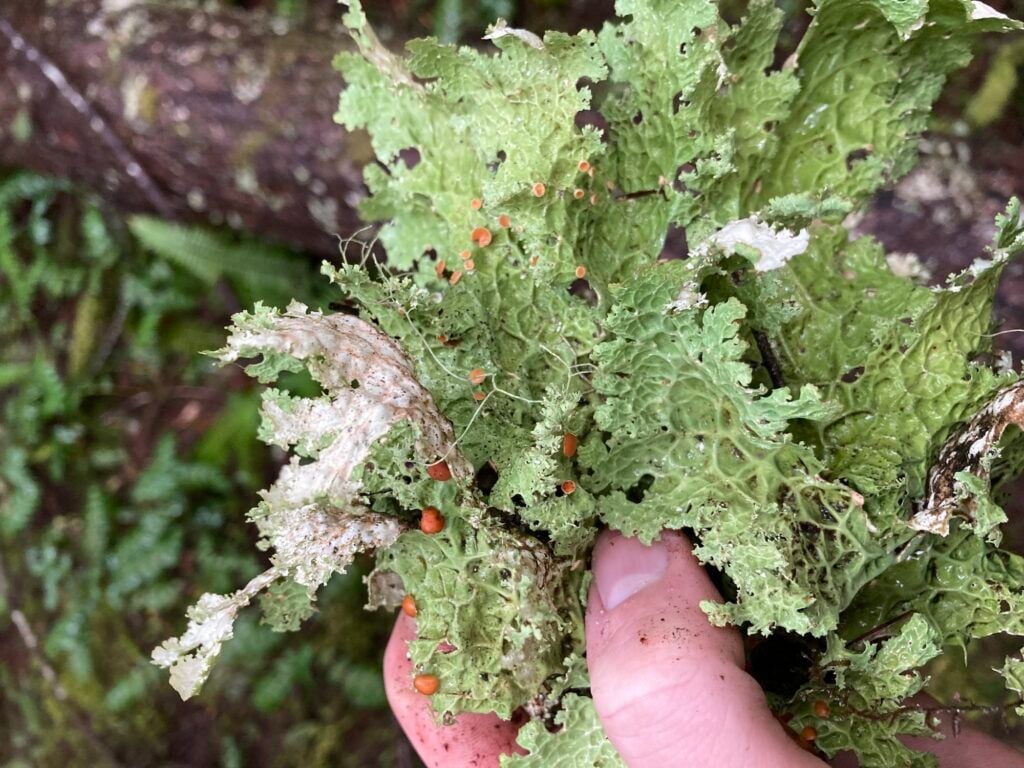
Not only does it look like a salad, during winter storms, lettuce lichen often gets knocked to forest floor where deer eat it. Photo by Colton Veltkamp/Wikimedia.
Lichens can thrive in some of the driest, harshest environments on the planet. Their trick? When conditions dry out, they can go dormant for weeks, months, or even years, then awaken when moisture returns. Most plants can’t do this. Even mosses need liquid water to rehydrate, while lichens can pull their water from humid air.
This makes lichens right at home in the upper redwood canopy, where summer conditions are often quite dry and much of the moisture comes from fog. A single redwood tree may harbor a few dozen lichen species.
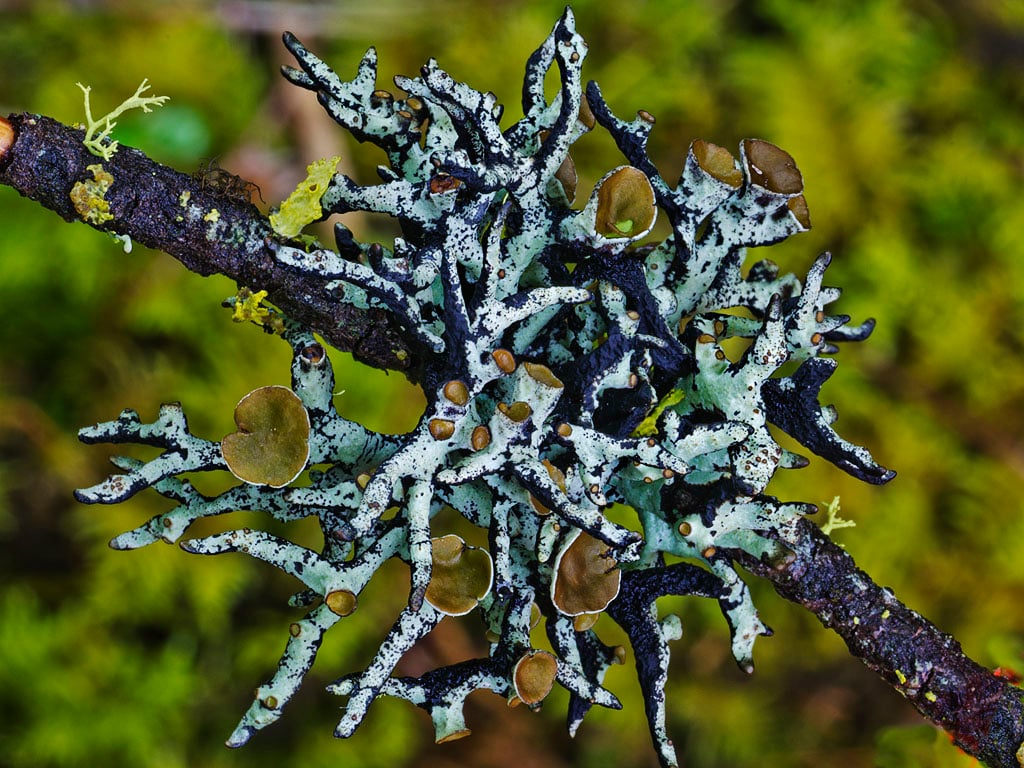
Visit a mature redwood forest after a storm, and you’ll often see lichens as pops of color among the twigs and branches scattered on the ground: blobs of pale gray-green, cream, taupe, and citrine, with occasional splashes of red or black. These otherworldly lichens coat redwood limbs, dangle from them, or jut from their surfaces. They offer an up-close look at redwood-inhabiting lichens normally hidden from view.
For most of us, these fallen branches offer the only glimpse of an alien world hundreds of feet above in the redwood canopy.