November 16, 2026
My first instinct was to turn and run. Just a few yards away, flames crawled through the forest toward me as I stood next to a flammable tangle of dead leaves and branches. Hot swirling winds sent glowing embers drifting uncomfortably close to my face. I swatted them away like red-hot flies. When the flames reached a spindly tanoak tree nearby, it ignited with a whoosh.
Every neuron in my brain screamed the same message: Time to go!
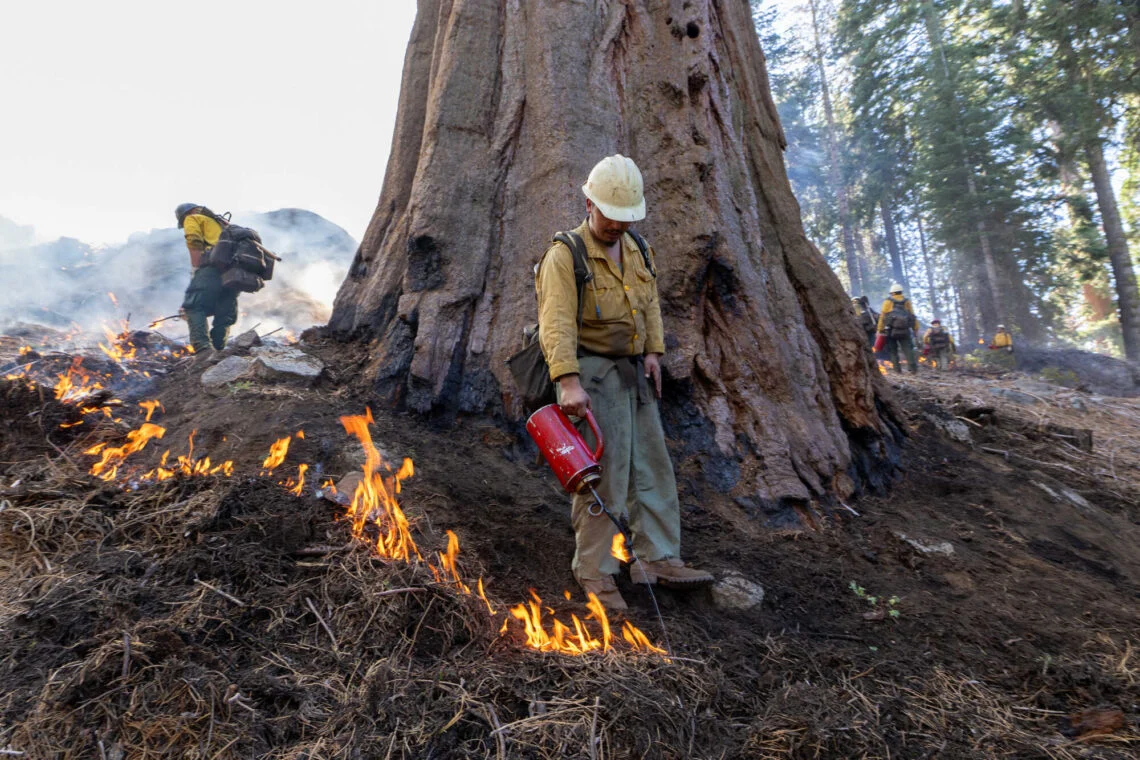
But this was no raging wildfire, and I wasn’t in any real danger. It was a carefully orchestrated prescribed burn at Harold Richardson Redwoods Reserve in Sonoma County, a spectacular old-growth redwood forest protected and stewarded by Save the Redwoods League. All around me, well-trained professionals buzzed through the forest, monitoring the fire’s progress, encouraging its growth in the misty weather, and standing ready to extinguish the burn if necessary.
Watching a prescribed burn up close gave me, someone who had known wildfire mostly through photos and headlines, a new respect for the power of fire.
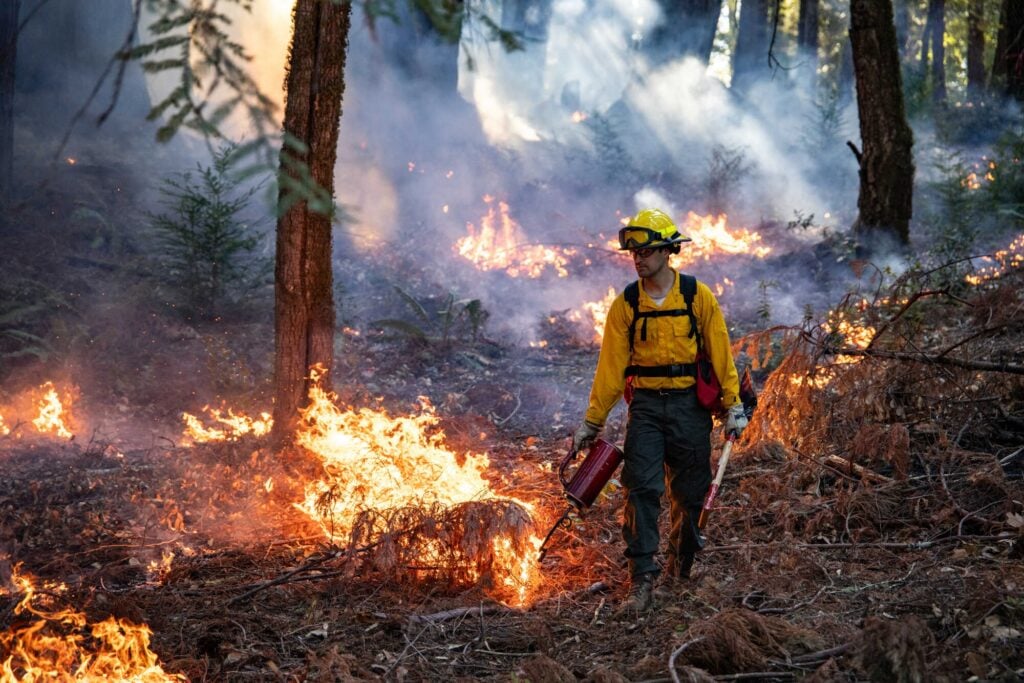
Anthony Castaños, senior land stewardship manager at Save the Redwoods, lays a track of fire on years of accumulated brush at Harold Richardson Redwoods Reserve. Photo by Sashwa Burrous.
Restoring an essential process to redwood forests
Fire was a regular part of California’s forests for millennia, sparked by lightning or set by Indigenous people, who have long used cultural fire to steward the land. These frequent, lower-intensity fires helped shape healthy forests, clearing out vegetation without the devastating effects of the catastrophic wildfires we know today.
But beginning in 1924, total fire exclusion became the official policy of land managers in the state. For the better part of the next century, a natural process that had shaped these forests was largely kept out of them.
As the ecological costs of fire exclusion became clear, prescribed fire advocates began sounding the alarm: Keep fire out long enough, and dead wood and dense vegetation pile up, priming forests for incredibly destructive—and costly—megafires. By the late 1960s and early 1970s, land managers were cautiously bringing prescribed fire back to places like Sequoia National Park and Calaveras Big Trees State Park. Only recently, though, has beneficial fire gained wider acceptance.
In fall 2024, Save the Redwoods held its first prescribed burn at Harold Richardson Redwoods Reserve, following earlier prescribed fire work elsewhere. Though relatively small at just 16 acres, it marked a milestone: It was the first prescribed burn Save the Redwoods conducted in a coast redwood forest.
Its success paved the way for two more burns at the reserve, one this past spring and the most recent in late October. So far, some 59 acres have been burned, with larger treatments planned for the near future.
“Ideally, the vast majority of the property will be treated with fire,” says Anthony Castaños, senior land stewardship manager at Save the Redwoods. “The plan is that each successive burn is bigger than the last, which builds greater fire resilience, allowing us to safely treat larger areas over time.”
The old-growth trees at the heart of the reserve have responded to the burns as expected. That is to say, stoically and unbothered. After all, they’ve seen fire before. Their thick, porous bark evolved to deal with it.
Save the Redwoods staff are keeping a close eye on how the trees and the rest of the ecosystem respond to these burns through extensive data collection. What they learn here will help shape future prescribed burns at other coast redwood properties.
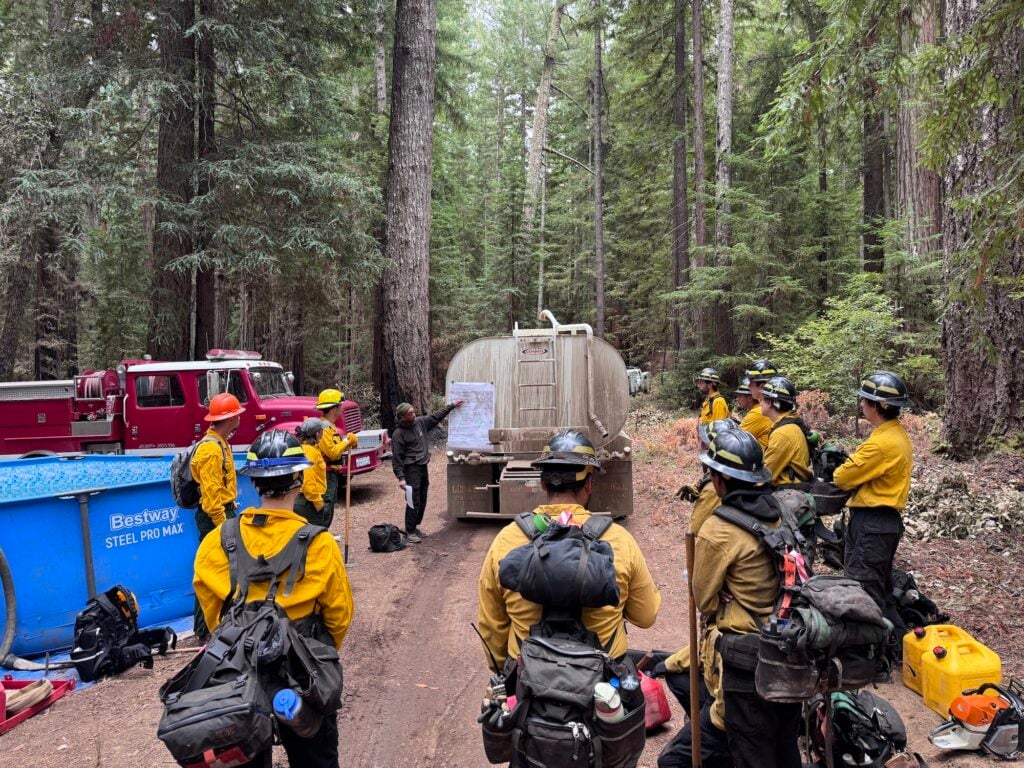
Sterling Minter of Biswell Forestry goes over safety protocols and burn locations during the morning briefing. Photo by Justin Housman.
Working with fire, carefully
Having never been to a prescribed burn before, I expected to find unfamiliar equipment at the staging area: drip torches, strange axes and cutting tools, maybe even little tractors for pushing logs around.
I didn’t expect swimming pools. Yet there they were, of the above-ground variety, filled with mirror-smooth water, complete with “No Diving” signs.
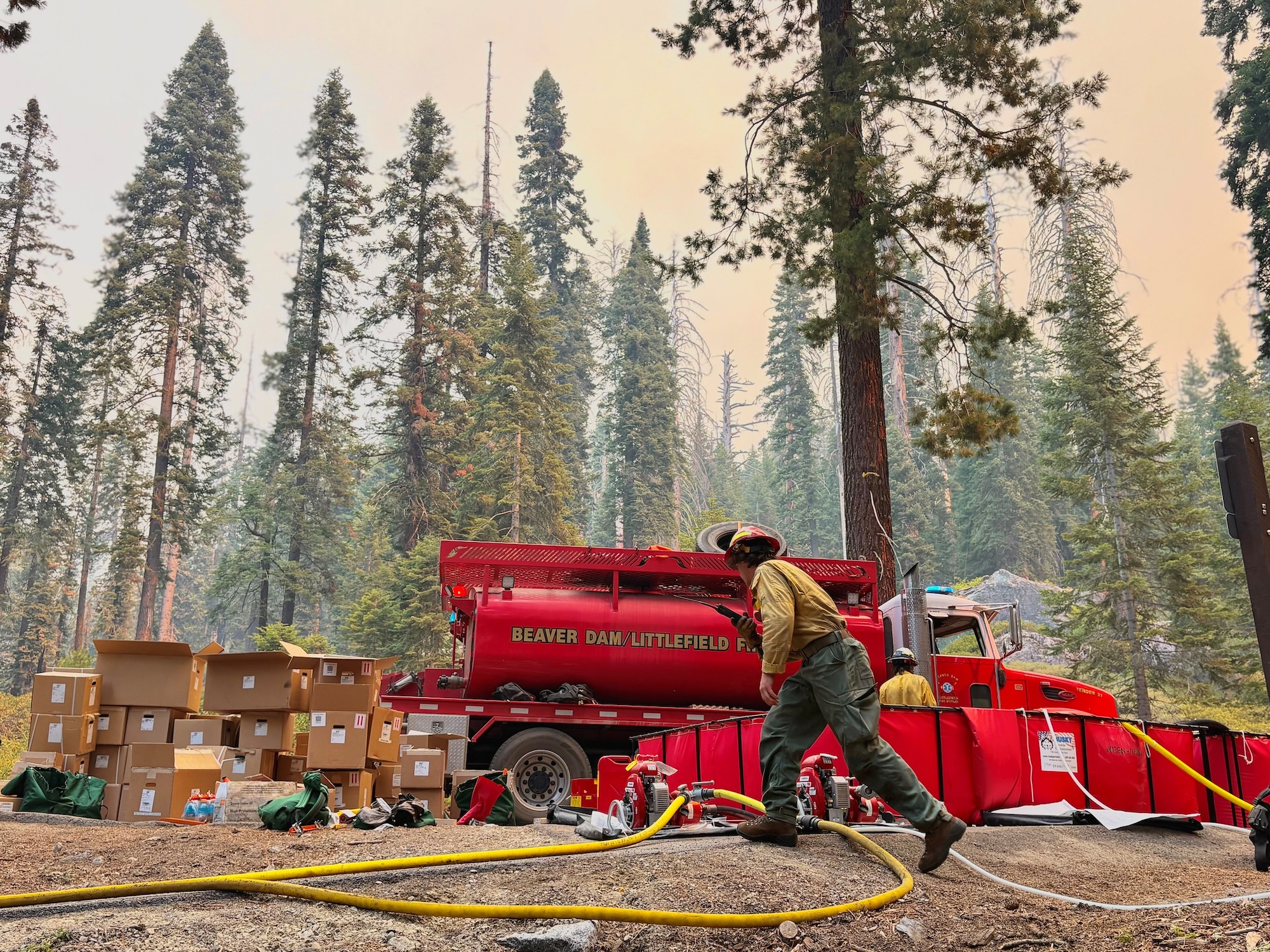
Having plenty of water on hand is crucial to keeping a prescribed burn under control. In fact, water dominated much of the morning briefing. Sterling Minter, the burn boss in charge of the day’s proceedings, stood in front of a tanker truck and ran his crew through the locations of the swimming pools, water trucks, and hose lines positioned around the planned burn area.
Many of those things had been placed days earlier, when preparation for the burn began, including burning piles of vegetation gathered during fuels-reduction work.
The reserve is a challenging place to conduct a burn. It’s remote, with steep topography and huge trees rising from narrow drainages. Because of bird nesting seasons and months of fog and rain, the ideal timeframe for burning is narrow.
But it’s a challenge Minter enjoys.
“It’s an honor to do this work in old-growth redwood forests,” Minter says. “These burns are like witnessing a rare natural event—like a volcanic eruption, an eclipse, or finding a meteorite. It stays with you, and you want to keep bringing that experience to more of the forest.”
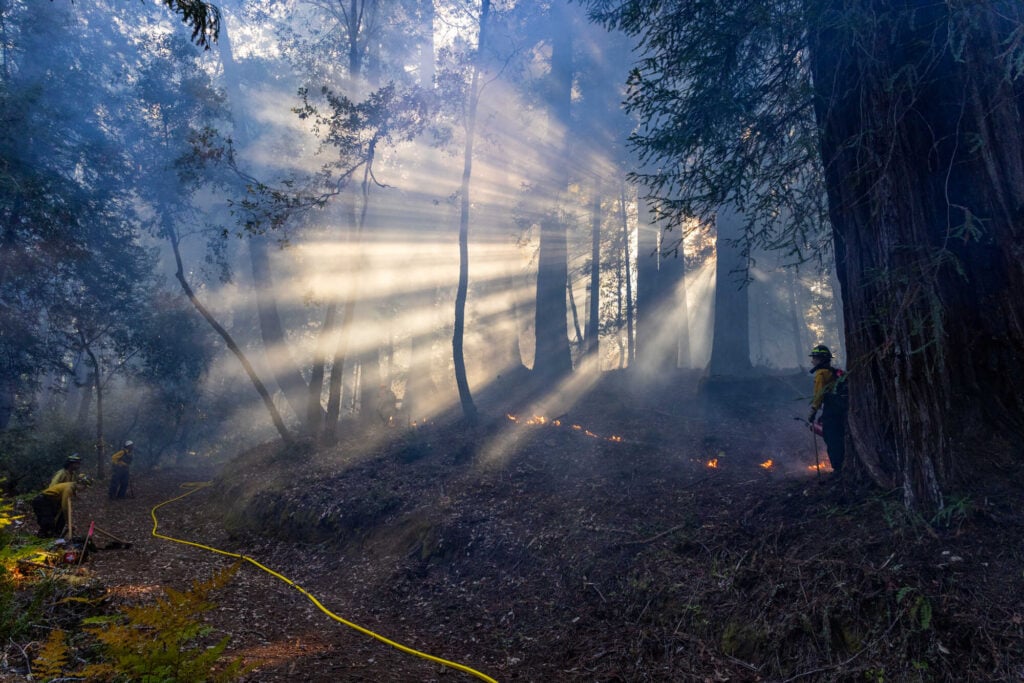
Bright yellow firehoses are a constant presence at prescribed burn sites. Safety first, after all. Photo by Sashwa Burrous.
When fire feels natural
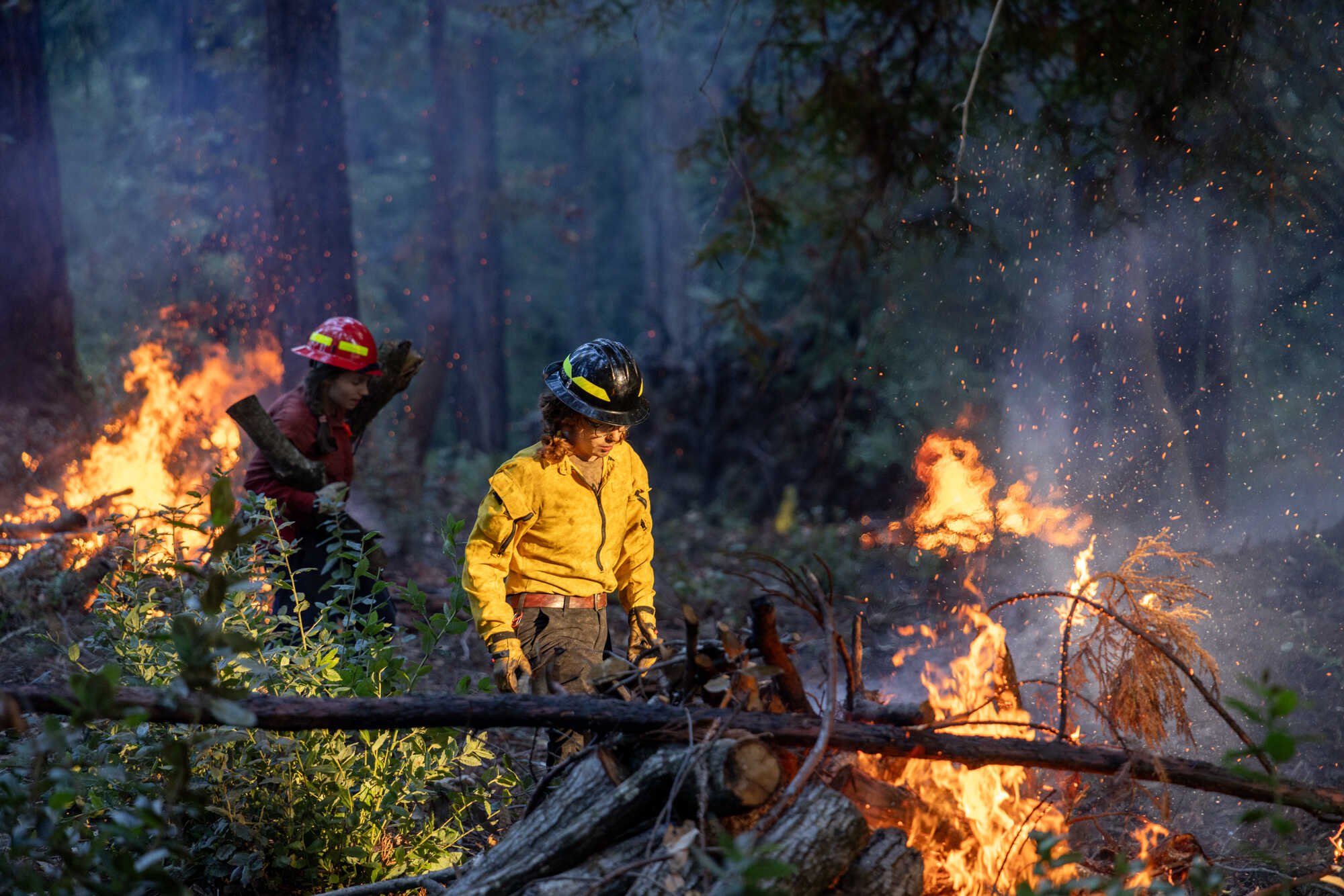
When the burn began, every lesson about extinguishing campfires and every wag of Smokey Bear’s finger flashed through my brain. Here were people deliberately dripping flaming liquid onto dry leaves and branches on the forest floor. As the flames grew and hot winds blew, I looked on in astonishment as the crew calmly went about their work, surrounded by creeping lines of fire.
Though this was only a low- to moderate-intensity burn, the energy released by the flames was remarkable. It drove home just how horrific and destructive a full-scale megafire must feel up close, and why prescribed fire is so necessary in forests that have gone unburned for decades.
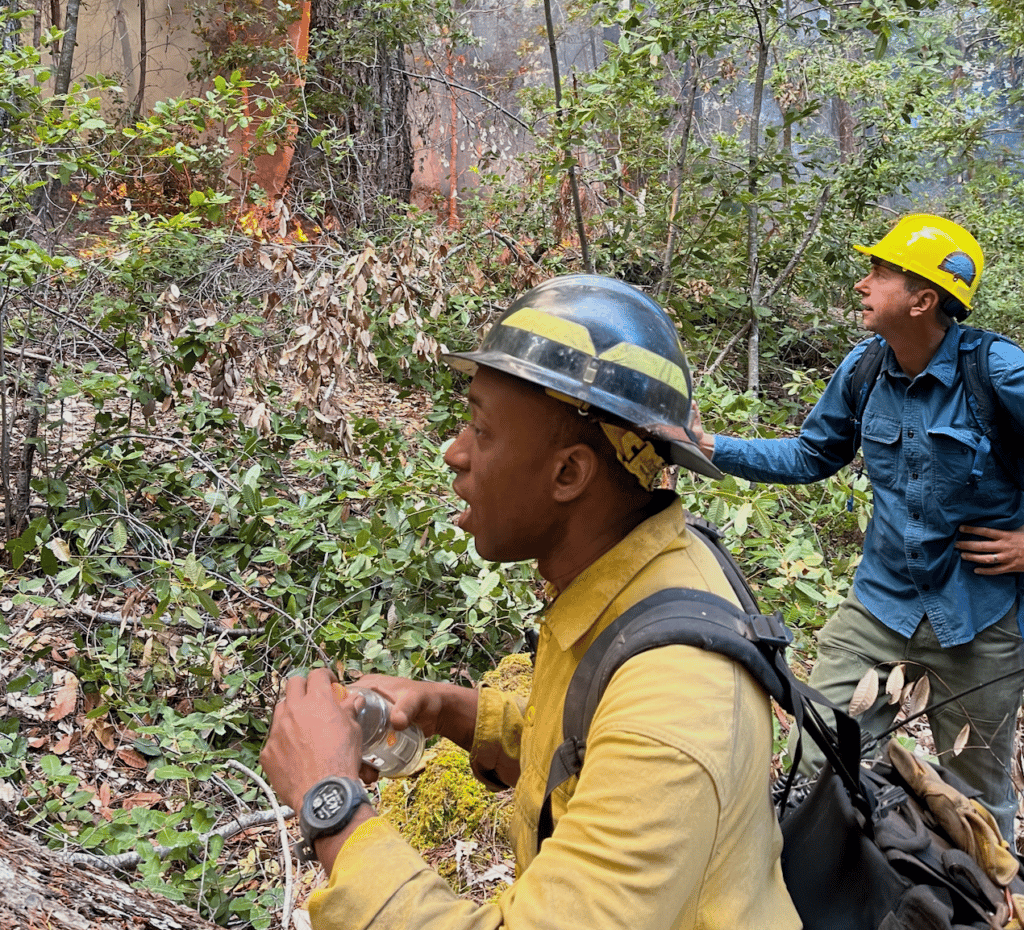
Minter and the author watch the flames move into a drainage that hadn’t seen fire in many decades. Photo by Ben Blom.
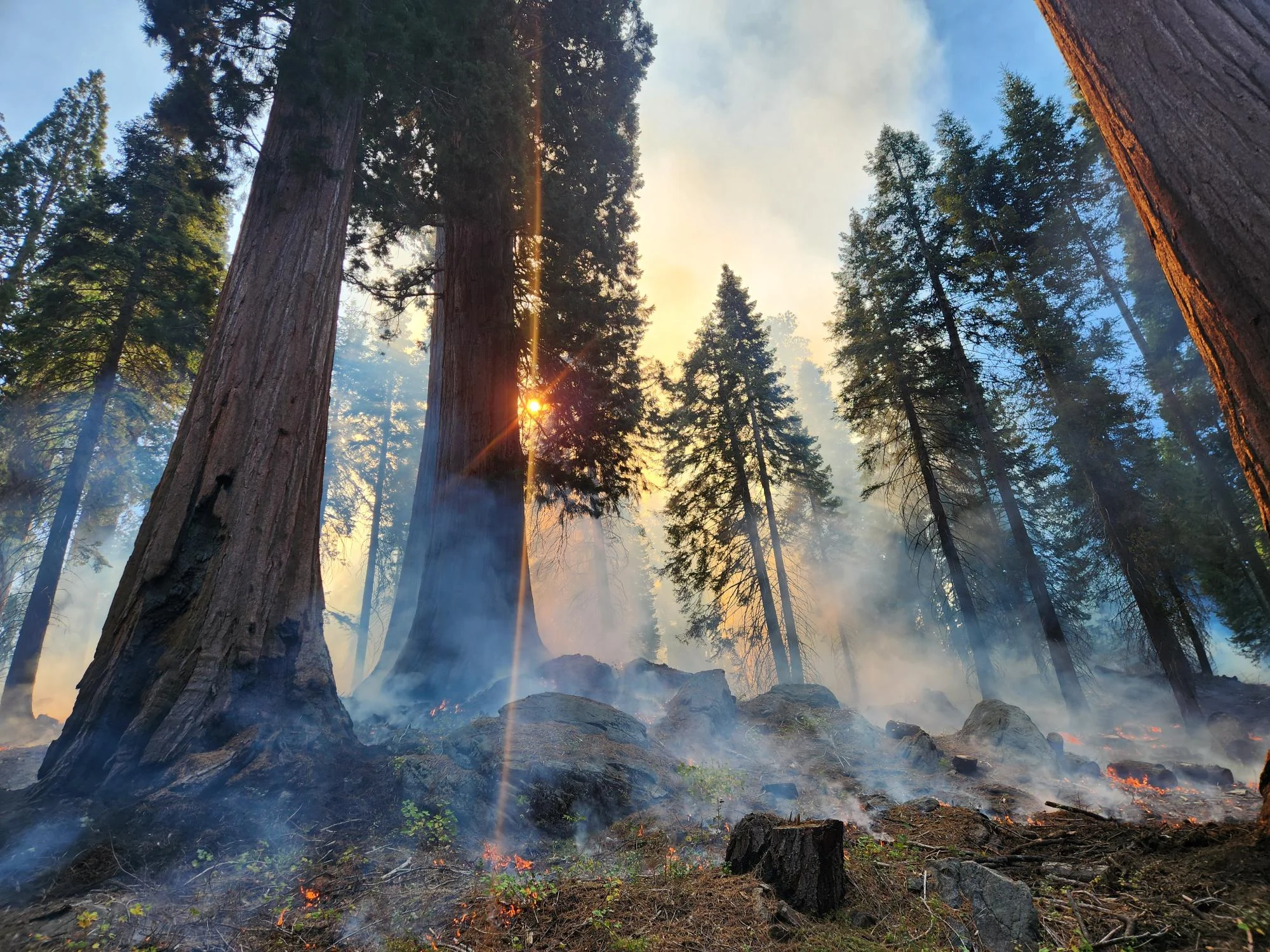
Later in the day I joined Minter on a walk around the fire’s perimeter, stopping for a few moments at that tangle of dried brush I’d waded into earlier. We stood there for a time without speaking, just watching the flames. When a forest floor burns it sounds surprisingly like rain. Dry leaves and branches crackle and pop as they catch fire, like the pitter-patter of raindrops. Swirling winds hiss through branches and bend entire trees as if in a storm.
It all felt so … natural. I looked up at an old-growth mammoth as a trickle of flames crawled up its trunk. Immediately, everything I’d read about how these trees evolved with fire was right in front of me. They were simply doing what redwoods have always done. For the first time that day, the fire didn’t look like something happening to the forest. It looked like part of the forest itself.
“We know that fire is an ecological process,” Minter told me later. “We know that humans were putting fire into these forests for a long time and that the forests expect fire as part of a balance. We’re just trying to get back to that.”