California's magnificent coast redwoods are one of the world's oldest trees. In the most favorable parts of their range, they can live more than 2,000 years. However, ancient coast redwood are rare — only about 5% of the original forest remains today. The largest surviving stands of ancient coast redwood forest are at Humboldt Redwoods State Park, Redwood National and State Parks, and Big Basin Redwoods State Park.
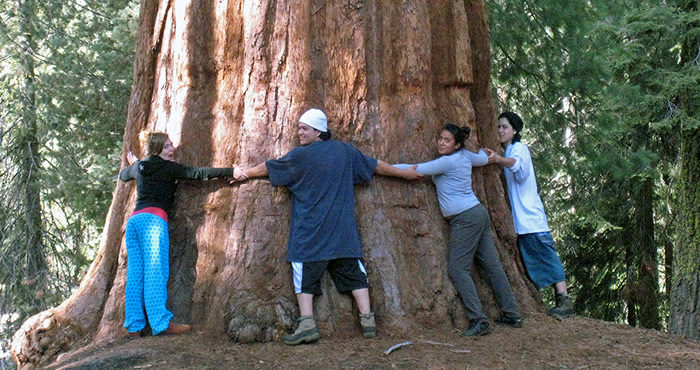
The coast redwood is one of the world's fastest growing conifers. Trees several hundred years old stand up to 240 feet tall with diameters at breast height of 10 to 15 feet. Some trees have been measured at more than 375 feet tall. In marked contrast to tree size, redwood cones are tiny — only an inch long. Each cone contains 14 to 24 tiny seeds. The seeds are so small that it would take well over 100,000 seeds to weigh a pound! In good conditions redwood seedlings grow rapidly, more than a foot per year in some instances. Young trees also sprout from their parent's roots, taking advantage of an established root system and the energy and nutrient reserves contained within them.

Its scientific name, Sequoia sempervirens, comes from the Cherokee Indian Chief Sequoyah (1776-1843) and "sempervirens," Latin for "evergreen." The more common name, redwood, refers to the color of its bark and heartwood. The high tannin content of the wood gives the trees remarkable resistance to fungal disease and insect infestation. The thick, fibrous bark has even higher tannin content and insulates the trees from the periodic fires that have occurred naturally over the centuries in the redwood region. These hearty trees have delicate foliage. Narrow, sharp-pointed needles only one-half to three-quarters of an inch long grow flat along their stems, forming feathery sprays.

Coast redwoods form almost pure stands in some areas — especially on flat, silt-covered river plains — but they are also found in mixed evergreen forest with the majestic Douglas fir, as well as western hemlock, grand fir, and Sitka spruce. On drier slopes tan oak, madrone, maple, and California bay laurel grow along with the evergreens. Other plants flourish under the trees in the duff of fallen needles, including rhododendron, hazel, and redwood sorrel.
Animals found in the redwood forest include mammals such as black bears, Roosevelt elk, deer, raccoons, squirrels, porcupines, and martens. Among the birds found here are the marbled murrelet and the northern spotted owl, both of which nest almost exclusively in old-growth redwood and Douglas fir forest. Many visitors to the redwoods notice salamanders, newts, and the yellow banana slug (a common mollusk).
Redwoods were once much more widespread than they are today. Paleobotanists have discovered fossil redwoods throughout what is now the western United States and Canada, Northern Mexico, and along the coasts of Europe and Asia. Based on the fossil record, redwoods have been present in their current range for about 20 million years. It is generally believed that the last ice age may have forced the coast redwoods into their present range: a narrow 450-mile strip from central California to southern Oregon, which is rarely more than 30 miles from the Pacific Ocean. In this "redwood belt," temperatures are moderate year-round; heavy winter rains and dense summer fog provide the trees with much needed water during an otherwise drought-prone summer in this Mediterranean climate zone. In fact, redwoods create their own "rain" by capturing the fog on their lofty branches. In this way they contribute moisture to the forest in the driest time of year.
The coast redwood forest is a perfect recycling system. The soil (like that in any high-rainfall climate) contains low levels of the nutrients all plants require. Most of the substance necessary for life is in the trees themselves, living and dead, and in the other plants and animals of the forest. If trees are removed from the forest, instead of being allowed to die and decay naturally, many nutrients are lost from the cycle.
Landscape architect Frederick Law Olmsted Jr. once said, "This generation has received, as a free inheritance from past ages, a hoard of forest wealth. But if any of the future generations for thousands of years to come are to have the opportunity of enjoying the spiritual values obtainable from such primeval forests, this generation must exercise the economic self-restraint necessary for passing on some portion of this inheritance, instead of 'cashing-in' on all of it."
Please donate to Save the Redwoods League to help protect these magnificent trees.
Walk Among Giants Online Photo Contest: Enter our photo contest to raise awareness of the world’s tallest trees to new heights! California residents, enter by July 23, 2009, for a chance to win great prizes. Non-California residents, vote for the winners from August 3 to September 7, 2009.