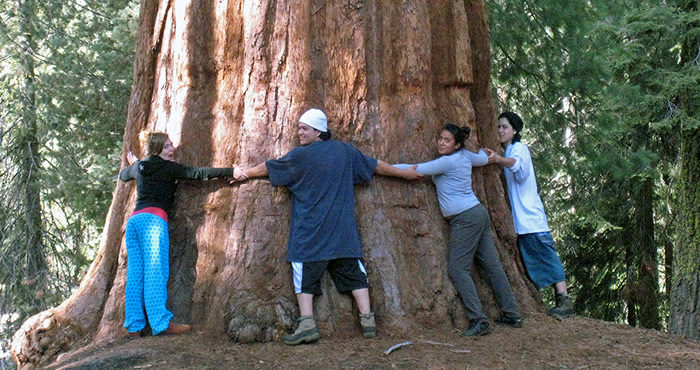
Giant sequoias in Yosemite National Park. League staff photo.

Education Resources

About Redwoods


Coast Redwood | Giant Sequoia | Dawn Redwood
Much More Than Just Trees

Three species of trees are commonly referred to as redwoods: California's coast redwood (Sequoia sempervirens) and giant sequoia (Sequoiadendron giganteum), and China's dawn redwood (Metasequoia glyptostroboides).

Redwoods get their common name from their bark and heartwood, the reddish-brown color of which stems from high tannin levels. Other chemicals found in the leaves, branches and bark give these trees a remarkable resistance to fungal disease and insect infestation. Their thick bark holds large quantities of water, which protects them from periodic, naturally occurring fires.

All three redwoods are descendents of a group of conifers (cone-bearing trees) that flourished more than 144 million years ago when dinosaurs roamed the Earth. At that time, the Earth’s climate was warmer and more humid than it is today, so redwood species grew throughout North America, Europe and Asia. Over time and in response to an ever-changing environment, they retreated from most of their former range, and many once-abundant redwood species became extinct.

Successive ice ages, including the last one that ended about 10,000 years ago, have restricted the remaining redwood species to three small, distinct regions, each supporting one of the species. Each region is the only place in the world where you will find native populations of that species.

Redwoods Are More Than Trees

It is important to remember that redwoods are not just trees — they are part of complex ecosystems that depend on and support them. About 18 percent of the remaining ancient coast redwood forests is protected in parks and reserves; more than 90 percent of giant sequoia acreage is in public ownership. Much work remains to ensure that future generations can enjoy these magnificent forests.

Unsustainable logging and poorly planned development continue to be major threats to redwoods. In California, thousands of acres of ancient coast redwood forest are on private land and could still be logged for lumber or to make room for development. While mature giant sequoia trees themselves are too brittle to produce useful lumber, real-estate development near the groves threatens the ecosystem on which they depend. In China, much of the dawn redwood forest was logged to make room for rice terraces; as a result, the ecosystem is extensively fragmented, even though dawn redwoods are now protected there. The future of all redwoods depends on conserving not just the trees, but all redwood ecosystems and connecting landscapes.

The League also considers climate change a threat to redwood ecosystems. Many scientists are concerned that rising temperatures and changes in weather patterns may further limit the range of redwood forests. Together we are studying the potential effects of climate change to determine how best to protect these awe-inspiring ecosystems.

Help Save the Redwoods League protect these magnificent trees.

For More Information:


Since 1918, Save the Redwoods League has saved ancient redwood forests and redwood ecosystems to ensure that current and future generations can feel the awe and peace that these precious natural wonders inspire. We also save redwoods because they are rare — their natural range is only in central and northern California and southern Oregon — and because they are Earth’s tallest and some of the oldest and most massive living beings.