Donate NowJoin Us on FacebookShare

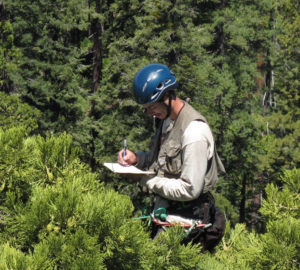
Todd Dawson
Todd Dawson, a recipient of Save the Redwoods League
research grants, studies the effects of climate change in
the redwood canopy. George Koch photo.

Protect Resources

RESEARCHING REDWOODS AND CLIMATE CHANGE

The Save the Redwoods League Research Grants Program focuses in part on advancing scientific knowledge related to redwood ecosystems and climate change. Understanding the fundamental ecology of coast redwoods and giant sequoias has always been important in protecting and restoring redwood forests.

Research such as that of League grantee Todd Dawson, a plant physiologist and ecologist, has become essential if we are to understand how to save these sentinels in the face of rapid climate change. Read about our new Redwood Climate Change Initiative.

Research to Help Redwoods Survive in a Changing Climate

By Joan Hamilton

If you’re out hiking and see a trim man in a hard hat ascending a redwood, it just might be the recipient of a 2008-9 research grant from Save the Redwoods League. Professor Todd Dawson, a plant physiologist and ecologist, has spent nearly two decades climbing and studying the world’s tallest trees. With help from Save the Redwoods League, he’s currently focused on the biggest challenge of his adventuresome career: helping coast redwoods (Sequoia sempervirens) and their inland relatives, giant sequoias (Sequoiadendron giganteum), weather the storm of climate change.

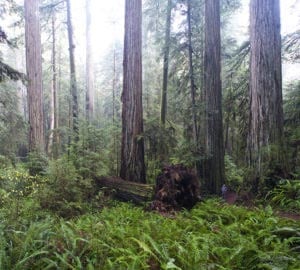
Coast redwoods live in a 450-mile-long fog belt that extends from central California to southern Oregon. Dawson and his colleagues at the University of California, Berkeley, were the first to figure out that coast redwoods condense enough fog to provide a large part—20 to 40 percent—of the total precipitation inputs to the coast redwood forest. In other experiments, the team proved that redwoods could soak up this water through their leaves as well from “fog drip” at their roots, helping explain how they can grow so tall. (The two tallest trees on record are just under 380 feet.)

Answering those questions led to a new one. How is global warming changing the life-giving fog belt? Working with Dawson, graduate student Jim Johnstone pored over airport records and discovered that over the past half century the average number of foggy days along the Northern California coast has declined by about 24 percent. At the same time, California’s growing population has been removing some of the trees that collect the fog. “We began to realize that humans were changing the whole hydrologic system of the redwood coastal region,” Dawson said.

In 2001, Save the Redwoods League encouraged Dawson to join the organization’s 60-member Board of Councillors. “Understanding the fundamental ecology of these trees has always been important in protecting and restoring redwood forests,” said League Executive Director Ruskin Hartley. “Dawson’s work has become essential if we are to understand how to save these sentinels in the face of rapid and unprecedented climate change.”

From 2002 to 2008, Dawson completed six studies at least partly funded by the organization, exploring everything from how redwoods soak up carbon in the air to how sword ferns survive in California’s dry summers (they can rely almost exclusively on water from fog).

Dawson’s 2008-9 Save the Redwoods League grant will take him, graduate student Anthony Ambrose, and their tree-climbing scientific colleagues to the southern Sierra Nevada, where rising temperatures are shrinking the snow pack, leaving less water for vegetation in the summer. They’ll be studying the inner workings of three giant sequoias near Kings Canyon National Park.

Giant sequoias are shorter than coast redwoods, but even so, “the top of the tree at 250 feet and the bottom at 80 feet are very different environments,” Dawson said. “How does that affect their performance?” From lofty perches, the researchers will study how the trees take in water from the soil and carbon dioxide from the air. Then they’ll compare how different microclimates and the form of the trees—including the number, length, and height of branches—affect these and other functions. The research will help determine what the trees need to thrive and how damaged forests might be restored.

What would restoration efforts likely entail? For the giant sequoias, cooler habitats in the north and at higher elevations might need to be protected so the trees will have a place to move if their current range shrinks, Dawson said. For the redwoods, alien species such as Himalayan blackberries, now encroaching on new redwood seedlings at forest edges, could be removed. Even some native species such as white fir, coming in thickly on the forest floor, could be thinned out to improve redwood regeneration.

Dawson grew up in an outdoorsy family that took him to see the redwoods as a child. He was dazzled, even then: “When you are little, you look up and you just can’t believe how big those trees are.” Now he’s scaling the same heights to find answers for science, policymakers and the public. “We’ve got to get the word out—to help keep these forests alive for our grandchildren and great-grandchildren. That’s what this is all about.”

More of Todd Dawson's redwood research

More redwood research and available grant reports

Double the impact of your gift to our new Redwood Climate Change Initiative—please donate to the Ken Fisher Matching Fund


Since 1918, Save the Redwoods League has saved ancient redwood forests and redwood ecosystems to ensure that current and future generations can feel the awe and peace that these precious natural wonders inspire. We also save redwoods because they are rare — their natural range is only in central and northern California and southern Oregon — and because they are Earth’s tallest and some of the oldest and most massive living beings.