
Restoration partnership makes headway in healing Redwood National and State Parks
When you first see a Ponsse harvester in action during a forest restoration project, it’s hard to believe a machine so powerful can work with such a light touch. Its massive, articulated arm carefully removes individual trees from dense stands, while specially designed tracks tread gently across the forest floor, minimizing impact. If you can picture a bulldozer wearing ballet slippers, you’re not far off. It’s a modern marvel and plays a vital role in healing young redwood forests recovering from decades of industrial logging.
The Ponsse harvester is just one of the many tools used by Redwoods Rising, a partnership between Save the Redwoods League, California State Parks, and the National Park Service. Together, the partners are restoring forests damaged by early industrial logging in what is now Redwood National and State Parks (RNSP), home to nearly half of the world’s protected old‑growth redwoods. While hundreds of ancient trees still stand, much of the surrounding forest is still badly scarred and unlikely to recover in the foreseeable future without help.
Now in its eighth year, Redwoods Rising is well on its way toward achieving the ambitious goal of healing and restoring 70,000 acres of previously logged forest within RNSP over the next three decades. Since 2020, the partnership has carried out restorative thinning and forest treatment across more than 5,000 acres, has removed 39 miles of failing roads, and has rehabilitated nearly six miles of streams.
Big ambitions, careful work
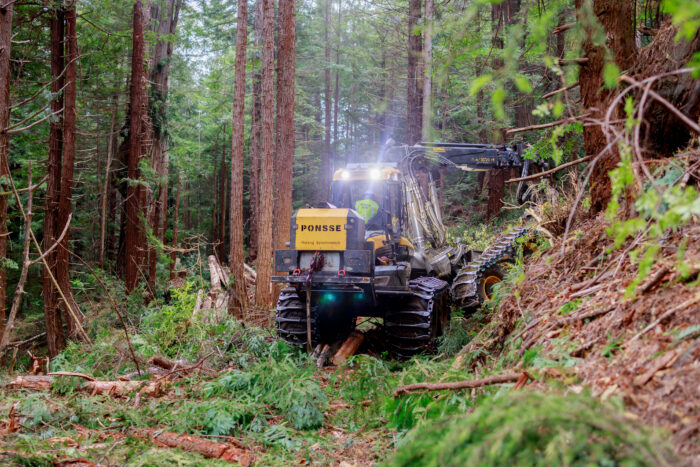
Decades of commercial-scale industrial logging in RNSP have left behind unhealthy forests that are a far cry from the thriving old-growth ecosystem that evolved there, characterized by open forest floors, rich biodiversity, and pristine wildlife habitat.
Many logged areas were extensively replanted with dense stands of Douglas-fir and other non-redwood species, creating dark forests filled with tall, spindly trees competing for sunlight. The old-growth redwood groves that remain are islands of ancient trees in a sea of second-growth forests lacking in biodiversity and prone to wildfire. Carefully and responsibly thinning the overcrowded young trees is a crucial part of the healing process.
Commercial logging also left scars beyond the trees themselves. Over the decades, a chaotic web of logging roads was carved through the terrain. As they eroded, the abandoned roads sent sediment sloughing into nearby streams, choking off waterways and blocking passage for native salmon and trout. Redwoods Rising is working to repair or remove more than 300 miles of old logging roads within RNSP—that’s enough road to take you from the heart of Humboldt County to San Francisco.
An impactful year on the ground and in the water
In 2025, the partnership made significant progress on rehabilitation work across its two main project areas, Greater Mill Creek and Greater Prairie Creek.
Last summer, forestry contractors worked alongside Redwoods Rising staff to carry out restoration thinning across hundreds of acres, setting the stage for today’s second-growth stands to become the old growth of the future. Other Redwoods Rising crews assisted road contractors in removing degraded asphalt, uncovering streams buried by logging road construction, and reshaping natural hillsides.
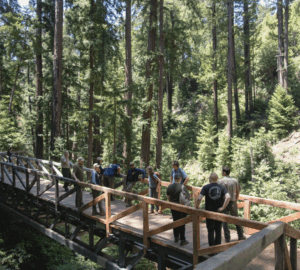
Some of this work was carried out through a partnership between the National Park Service and the Department of Defense, with members of the Air Force Reserve Innovative Readiness Team collaborating with Redwoods Rising on a bridge removal project as a hands-on training opportunity.
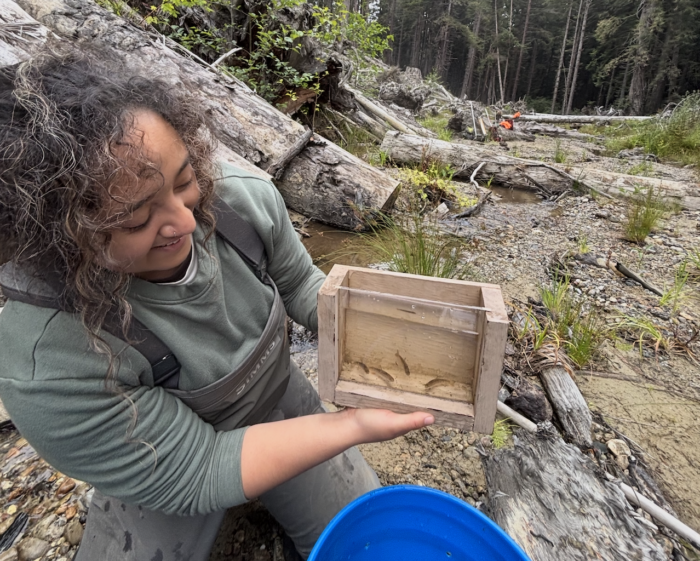
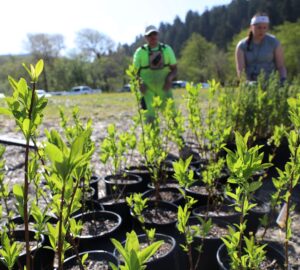
Meanwhile, aquatic restoration teams worked in streams and wetlands critical to tiny juvenile salmon and steelhead trout. Restoring these fragile ecosystems often means painstaking and hands-on care. Vegetation specialists planted scores of native plants to stabilize streambanks. Other field technicians, including Redwoods Rising Apprentices, pulled on their waders, rolled up their sleeves, and dipped into waterways to carefully move fish and amphibians, one by one, to safe areas prior to rerouting stream channels.
Restoring the forest, restoring the community
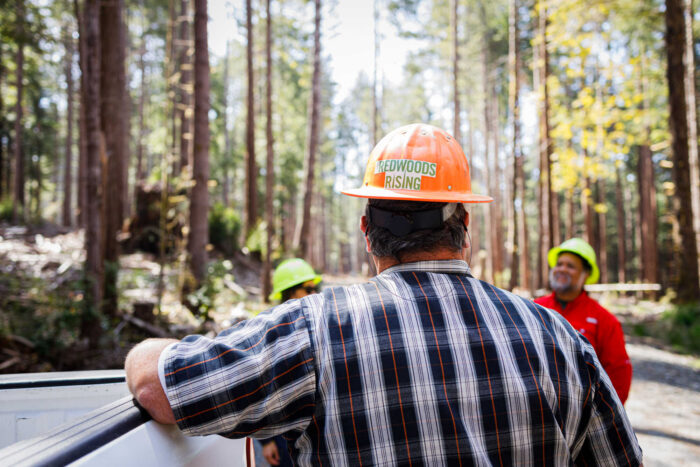
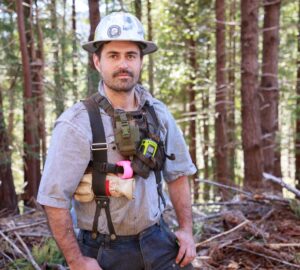
This restoration work benefits more than just forests and wildlife. Redwoods Rising supports North Coast communities by injecting dollars into local economies and providing well-paying restoration jobs in an area with high unemployment. Some of these restoration jobs are held by heavy equipment operators and foresters who originally learned their skills working for lumber companies. Now they’re working to heal those same forests.
Each year of Redwoods Rising progress makes the next one possible. With the 2026 summer restoration season just ahead, Redwoods Rising crews will once again be at work across RNSP, advancing thoughtfully designed projects that continue to heal these extraordinary forests—balletic Ponsse harvesters and all.
2025: Impact by the numbers
785 acres of previously logged forests selectively thinned to reduce overcrowding and allow remaining trees to grow stronger and healthier. That acreage is roughly the size of Central Park.
14 miles of decaying logging roads improved or removed entirely, reducing habitat fragmentation, improving water quality, and boosting redwood forest health.
3,696 feet of streams restored, which includes reconnecting natural stream flows and installing wood structures and native vegetation in waterways to bolster salmon habitat.
6 acres of floodplain rehabilitated in the Greater Mill Creek and Greater Prairie Creek project areas. Adult and juvenile salmon are already using the restored habitat, which is expected to support all life stages of salmon and lamprey, along with other native fish and amphibians, along with plenty of insects and bird life.
35 bridges and stream culverts repaired or replaced, to preserve healthy habitat for fish without removing water crossings needed for public, emergency, or restoration access.
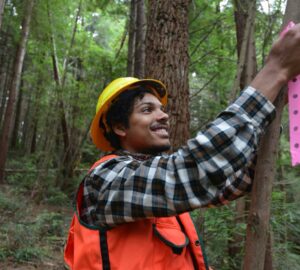
8 Redwoods Rising apprentices from Cal Poly Humboldt and College of the Redwoods beginning their careers as future natural resource managers.
3,840 hours logged by those apprentices gaining hands‑on experience measuring trees, learning cultural resource management, and mapping forests—sometimes even with lasers, to trace the contours of this rugged topography.




One Response to “A year of growing momentum for Redwoods Rising”
Mary Lou Rosczyk
What an encouraging video. Wishing successful careers as natural resource managers to those eight apprentices.