
Prakrit Jain’s quest to shed light on a mysterious mammal—with League help
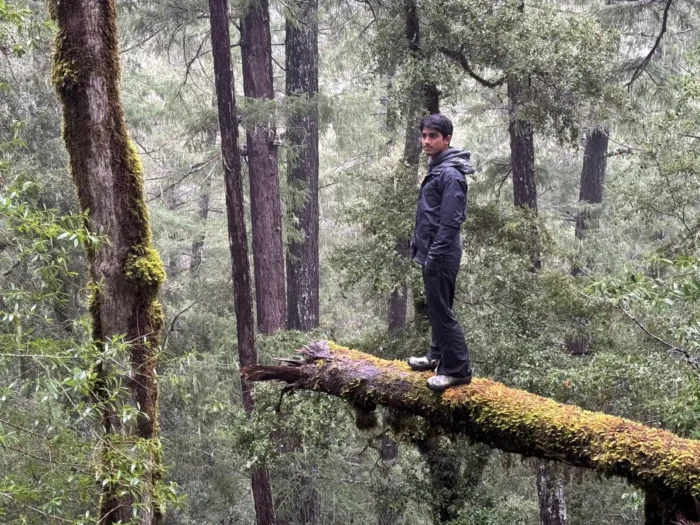
High above the loamy forest floor in coastal Northern California lives one of the planet’s pickiest eaters (no, it’s not a toddler). With specialized branch-grabbing claws and a semi-prehensile tail, this tiny nocturnal critter confidently moves through the crowns of huge conifers, munching down on the only food it eats: Douglas-fir needles. It’s the Sonoma tree vole, and if you’ve never seen one, don’t feel bad. Few people have.
One person working to change that is Prakrit Jain, a 2025 recipient of a Save the Redwoods League BIPOC student starter grant—a funding program meant to further the studies of emerging scientists (now accepting applications for 2026). Jain is a biology student at UC Berkeley, and he’s on a quest to document diminutive, seldom-studied species like the Sonoma tree vole.
“I was surprised by how many California mammals don’t have good photos available,” Jain says. “Some appear in very few photos at all.” Like the Sonoma tree vole, California’s tree-dwelling master of hide-and-seek. Jain applied for the League grant in part to help fill out the Sonoma tree vole’s photo album.

“When Prakrit reached out to our team to discuss his ambitious project idea, his enthusiasm for learning about Sonoma tree voles really stood out. He also had a great vision for sharing what he hoped to learn about the voles,” says Laura Lalemand, the League’s senior scientist. “We were impressed with all the preparation he’d done before he even met with our team.”
Indeed, Jain had done his research. He knew setting motion-activated camera traps was the only way he’d get video of the voles. He knew their range was limited to Northern California coastal forests. He knew they ate only Douglas-fir needles. He knew they lived 100 feet up in the trees. What he didn’t know—yet—was how to climb that high in a tree. So, he researched that too.
Jain and his project partner, Berkeley grad Vishal Subramanyan, enlisted the help of a UC Davis arborist and veteran tree climber. This tree-climbing tutor showed the duo how to handle themselves 100 feet off the ground, even with branches and needles poking their faces.
View this post on Instagram
This past April, Jain and Subramanyan headed for Mendocino County’s Angelo Coast Range Reserve. They used their new skills to climb trees and set up camera equipment, hoping to capture footage that would help researchers understand more about the evasive voles.
With both male and female voles measuring only about 3-4 inches long, these tiny creatures are thought to be a crucial food source for endangered animals like the northern spotted owl and the Humboldt marten, but little is known about how they engage with other species in their coastal forest habitat.

“We wanted to see how the voles are moving around the canopy,” Jain says. “We wanted to see how they interact with other animals, figure out when they’re most active, and what their nesting habits are like. Our camera traps are there to capture as much of the vole’s behavior as possible.”
Jain used student starter grant funds to buy camera equipment, secure tree-climbing gear, and cover frequent trips to the reserve to check camera footage and replace batteries. “The grant was instrumental in all of this work,” Jain says.
Thus far, the pair has collected plenty of video footage of voles scurrying along branches and nibbling on needles. Capturing a good photo is still proving elusive—like the vole itself.
Jain regularly moves cameras to capture new angles of vole behavior. Video courtesy of Prakrit Jain.This field-based research will help the League and our partners understand how animals move, feed, and find safe passage through the forest. With these insights, we can better protect vital corridors that keep redwood forest ecosystems healthy and thriving. Places like our recently acquired Sonoma Coast Redwoods property, which provides habitat for many unique species. Though Sonoma tree voles feed only on Douglas-firs, they roam throughout coastal forests wherever Douglas-fir and redwood habitats overlap. They’re a part of a complex web in which every species is connected to every other.
Plus, they’re just fascinating little creatures.
“Among worldwide rodents, there are very few species that are as specialized as these voles are,” Jain says. “I think it’s really kind of a shame that we know so little about this animal.”
For now, Prakrit. For now.
***
The League is now accepting BIPOC student starter grant applications through January 15, 2026. The goal of the program is to give students opportunities to explore research ideas related to coast redwood and giant sequoia forests. Interested in learning more? Visit our student starter grant website for details about the application process, grant deliverables, and criteria.


One Response to “Science grant lifts Sonoma tree vole researcher into the canopy”
Joseph Porterfield
Super to learn that the student is studying this elusive animal and that the League is assisting the research ! Redwoods are critical habitat for so many critters; saving redwood groves will allow us to learn more about what lives in these forests.